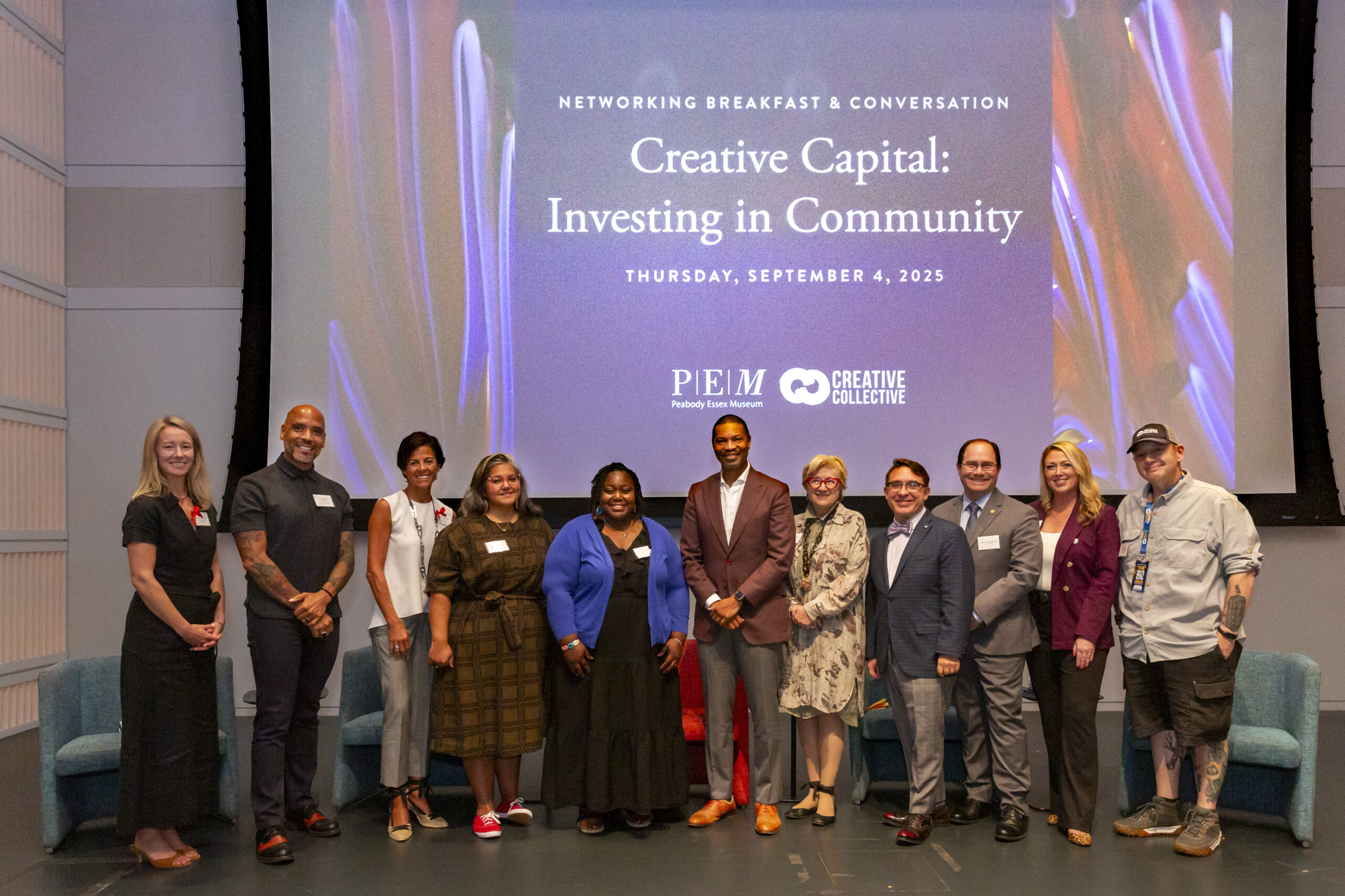

The energy in the Peabody Essex Museum‘s atrium on September 4 was unique. Furthermore, it was not the polite enthusiasm of typical morning panels, but the electric charge of people recognizing transformative change. As leaders gathered for Creative Capital: Investing in Community, organized by PEM in partnership with Creative Collective, they weren’t just discussing programs. Indeed, they were witnessing how Essex County’s support for its creative economy is fundamentally reimagining community investment in vulnerable members.
Lynda Roscoe Hartigan, PEM’s Executive Director and CEO, framed the gathering’s purpose perfectly. “Museums can be spaces where people can gather to talk about the issues of the time in ways that are positive and constructive,” she explained. Additionally, she emphasized how creativity contributes to shaping how we live together.

Courtesy PEM / Photos by Kathy Tarantola
Part I: The Crisis Requiring Essex County Creative Economy Support
Local Emergency, Statewide Disaster
In Salem specifically, Mayor Dominick Pangallo laid out stark numbers that shocked attendees. Two in three workers in frontline fields pay between 38% and 94% of their monthly income for rent. “Financial stress is now the leading cause of anxiety for Americans,” he noted. Moreover, he emphasized that the federal government isn’t just stepping away from this work—it’s running away from it.
Zooming out statewide, Michael J. Bobbitt of Mass Cultural Council presented comprehensive sector analysis data. Massachusetts employs 112,190 full-time artists, yet dancers earn a median annual income of just $7,000. Musicians earn $22,000; theater artists, $24,000. Consequently, twenty-eight of thirty-six artistic disciplines fall below the state’s $58,011 living wage.
The gap between income and survival is staggering throughout Essex County. Across the region’s thirty-four municipalities and 810,089 residents, single parents require $112,277 annually to meet basic needs. Furthermore, childcare costs alone render the $15 hourly minimum wage almost meaningless.
The Human Cost
John Andrews, founder of Creative Collective, articulated what these numbers mean in human terms. “When a potter can’t afford their studio, they don’t just lose a workspace, they lose who they are,” he explained. Additionally, when nonprofit directors burn out doing three jobs for one salary, entire missions suffer.
For creators and mission-driven organizations, business challenges and life challenges aren’t separate. They’re the same crisis. The consultant whose business plan assumed that after-school programs would exist. The restaurant owner whose excellent staff can’t afford nearby housing. The artist is choosing between arthritis medication and art supplies.

Creative Capital, Investing in Community, networking breakfast and panel discussion. Courtesy PEM / Photos by Kathy Tarantola
Part II: Three Revolutionary Essex County Creative Economy Support Programs
Against this backdrop, Essex County has become a testing ground for three interconnected programs. These initiatives blend federal pandemic relief funds, state initiatives, private insurance, and creative financing to address the crisis.
1. Salem’s Uplift: Direct Cash, Direct Impact
Salem’s guaranteed income pilot provides $500 monthly for 12 months to 100 residents living at or below the federal poverty line. The program targets individuals earning less than $15,060 or families of four earning less than $31,200. Moreover, the overwhelming demand—350+ applications in twenty-four hours—speaks to a desperate need.
Sarah Roy, who led the program for Salem, explained the philosophy behind this Essex County creative economy support initiative. “Choice goes beyond the immediate,” she said. “It starts with what kind of cereal my kid wants for breakfast. Once you have hope, a little ember within you, you’re able to breathe and think about what’s next.”
The program receives $685,000 in ARPA funds and support from UpTogether, which has distributed $210 million nationally since 2020. Additionally, Salem State University researchers are rigorously evaluating results by comparing 100 payment recipients against a control group.
Early evidence from similar programs is compelling indeed. Stockton’s pioneering program found recipients were 12% more likely to secure full-time employment. Meanwhile, Harvard’s evaluation of Chelsea’s program documented a 27% reduction in emergency department visits.
2. Arts as Literal Medicine
Massachusetts launched the nation’s first statewide arts prescription program in June 2024. Through this groundbreaking Essex County creative economy support system, healthcare providers write prescriptions for cultural experiences. These include museum visits, dance classes, and music performances—and insurance companies actually cover them.
The results are staggering. “People who have been prescribed arts prescriptions are going to their doctors 40% less,” Bobbitt revealed to the audience. Furthermore, arts organizations are finally being paid for work they’ve done for millennia.
Through the Mass Cultural Council’s partnership with Art Pharmacy and Mass General Brigham, patients receive twelve cultural experiences yearly. Among participants, 70% experienced mental health improvements. Additionally, 74% reported reduced loneliness, demonstrating the arts’ therapeutic power.
3. Hawthorne Lofts: Preserving Creative Community
North Shore CDC’s $22 million Hawthorne Lofts will deliver 29 affordable artist housing units upon completion in December 2025. However, the demand—290 artists applied—underscores the housing crisis facing creative workers.
Felicia Pierce, CEO of the North Shore CDC, connected housing to community vitality during her presentation. “When artists can’t afford to live where they create, entire communities lose their lives,” she explained. Therefore, this support for the creative economy in Essex County addresses cultural preservation through housing.
The development is intentionally designed to serve diverse income levels. Units accommodate residents earning 30% to 80% of Area Median Income. This acknowledges that even “successful” artists often earn below survival wages.

Karen Nascembeni (North Shore Music Theatre) John Andrews (Creative Collective) State Rep. Tom Walsh – Creative Capital, Investing in Community, networking breakfast and panel discussion. Courtesy PEM / Photos by Kathy Tarantola
Part III: The Theory of Change Behind Essex County Creative Economy Support
Breaking Poverty’s Gravitational Pull
Turahn Dorsey of Eastern Bank Foundation introduced the event’s most compelling framework: “escape velocity.” Borrowed from rocket science, this concept describes giving people enough resources quickly enough to break free from poverty’s pull.
“We will never earn our way across income gaps,” Dorsey explained bluntly to attendees. “If we’re actually going to close those gaps, we need to redistribute capital, full stop.” Thus, Essex County’s creative economy support recognizes that fundamental change requires significant investment.
In practice, this means $500 monthly might allow someone to fix their car. Subsequently, this enables them to take a better job, fundamentally changing their economic trajectory. Indeed, it’s not about minor improvements but about providing enough thrust to achieve orbit.
Trust as Revolutionary Act
Marianne Bullock of UpTogether emphasized that these programs share a radical premise: trusting people to know what they need. “Communities create solutions themselves,” she explained. For instance, one woman used $500 monthly to open a laundromat because the nearest one was three miles away. Now she’s a successful businesswoman.
This challenges traditional models that require financial literacy classes or prescribe aid usage. As Bullock noted, “We’re not going to investment bankers saying ‘here’s your paycheck, but be careful how you spend it.’ We’re only studying how poor people spend their money.”
Part IV: The Path Forward for Essex County Creative Economy Support
Immediate Actions
The panelists were unified in their call to action: organize. “Government responds to political pressure,” Bobbitt stated clearly. Meanwhile, Bullock added with humor, “If you can get seven people together for karaoke, get seven people together for your city council meeting.”
Specific steps emerged from the discussion:
- Join Mass Creative for arts advocacy
- Support the Massachusetts Poverty Coalition’s omnibus bill, which includes statewide guaranteed income proposals.
- Attend local government meetings when housing and zoning are discussed
- Share stories—”Storytelling has no bounds for who can hear it,” Pierce emphasized
Sustainability Challenges
These Essex County creative economy support programs face significant hurdles ahead. The Massachusetts Anti-Aid Amendment restricts direct public funding to individuals, requiring creative workarounds through nonprofits. Additionally, ARPA funds are set to expire soon, necessitating the need for new funding sources.
Yet momentum is building rapidly. Over 150 guaranteed income pilots across twenty-five states have distributed $2.35 billion. International arts prescription programs demonstrate decades of success. Therefore, the question isn’t whether these approaches work—it’s whether political will can match community need.
Beyond Charity to Investment
Turahn Dorsey challenged the room to think differently about support. “This isn’t charity, it’s investment,” he emphasized. These programs recognize that supporting whole humans—with all their complexity and potential—is the only sustainable path forward.
As Kurt Steinberg, PEM’s moderator, charged attendees at the event’s conclusion: “You can no longer say you don’t know. Think about how you can be a change agent in the community in which you live.”
The Essex County Model for Creative Economy Support
What makes Essex County’s approach revolutionary isn’t any single program but their interconnection. Guaranteed income provides stability. Arts prescriptions address isolation and mental health. Artist housing preserves community vitality. Together, they form an ecosystem that recognizes a fundamental truth: when we support whole humans, everything changes.
With 350+ Salem residents applying for guaranteed income within twenty-four hours and 290 artists seeking twenty-nine housing units, demand vastly exceeds supply. However, Essex County creative economy support has proven something crucial: communities can act even when federal and state governments won’t.
What You Can Do Now: The Power of Your Story
Felicia Pierce’s charge to the gathering was clear and powerful. “Don’t ever stop telling your story as a creative,” she urged. “Storytelling has no bounds for the possibilities of who can hear it, that has a deep connection with it that can make a change.”
Why Your Story Matters Now More Than Ever
When dancers earning $7,000 annually become statistics, policymakers can ignore them. However, when you share that you’re choosing between insulin and art supplies, that you’re teaching dance while living in your car, that you’ve contributed to your community for decades but can’t afford to stay—that becomes undeniable.
Turahn Dorsey reminded the gathering that creatives are natural provocateurs. “Now is the time for provocation,” he declared. Your story, told honestly and boldly, is that provocation.
Stories do what data cannot. They make the crisis personal, urgent, and fixable. Your story transforms “the arts” from luxury into necessity. It changes “affordable housing” from a political football into a fundamental human need.
How to Tell Your Story for Impact
Make it specific. Don’t say “rent is expensive.” Instead, say “I pay $1,970 for my apartment, which is 73% of my monthly income from teaching music to forty students.”
Connect personal to systemic. “This isn’t just my problem—I’m one of 290 artists who applied for twenty-nine affordable units at Hawthorne Lofts.”
Show your contribution. “I’ve taught 500 children to play instruments for over ten years, but I can’t afford to live in the community I serve.”
Include solutions. “With guaranteed income, I could fix my car and take the teaching position at the community center. Without it, I’ll have to leave the area.”
This story comes from the Creative Collective community – Essex County businesses who believe that when we thrive together, our whole region becomes more vibrant. We’re entrepreneurs, creators, and service providers across all industries, collaborating to build the community we want to be part of. If you see your business as more than just commerce – as a way to contribute to our regional ecosystem – you belong here. Discover how to join our community →

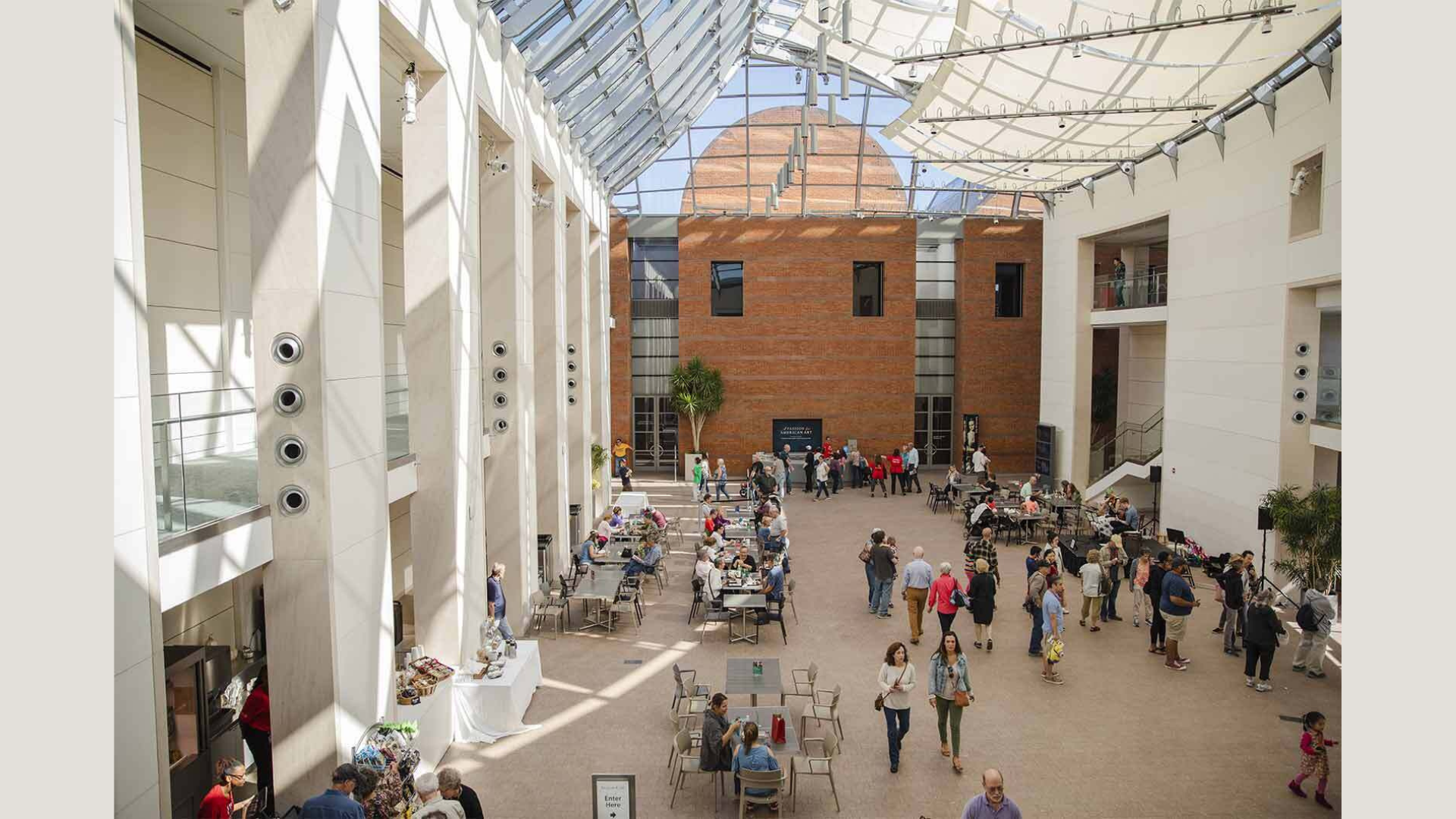
Peabody Essex Museum
View their Member Listing
The mission of the Peabody Essex Museum is to celebrate outstanding artistic and cultural creativity by collecting, stewarding and interpreting objects of art and culture in ways that increase knowledge, enrich the spirit, engage the mind and stimulate the senses. Through its exhibitions, programs, publications, media and related activities, PEM strives to create experiences that transform people’s lives by broadening
SEE LISTING