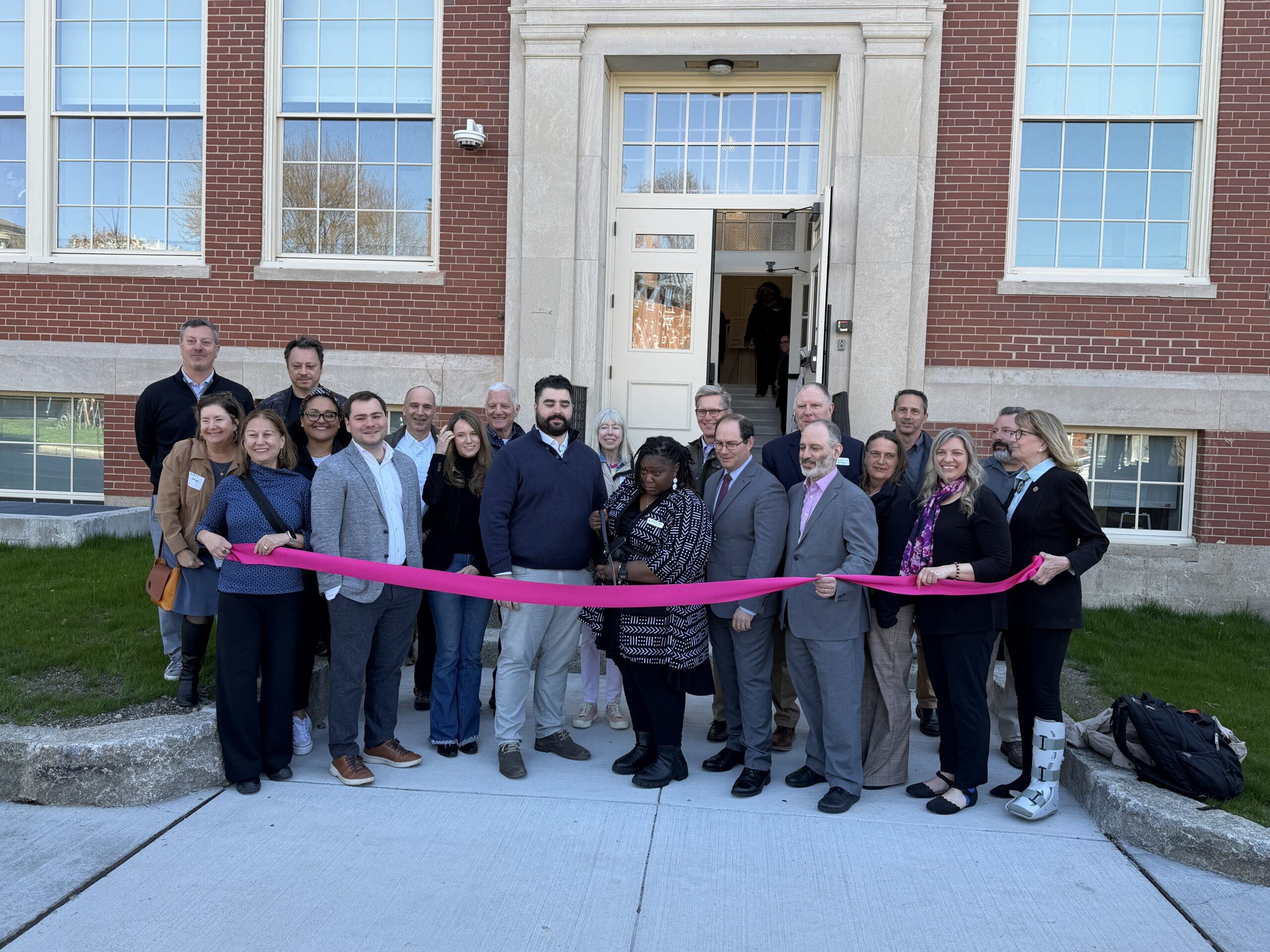
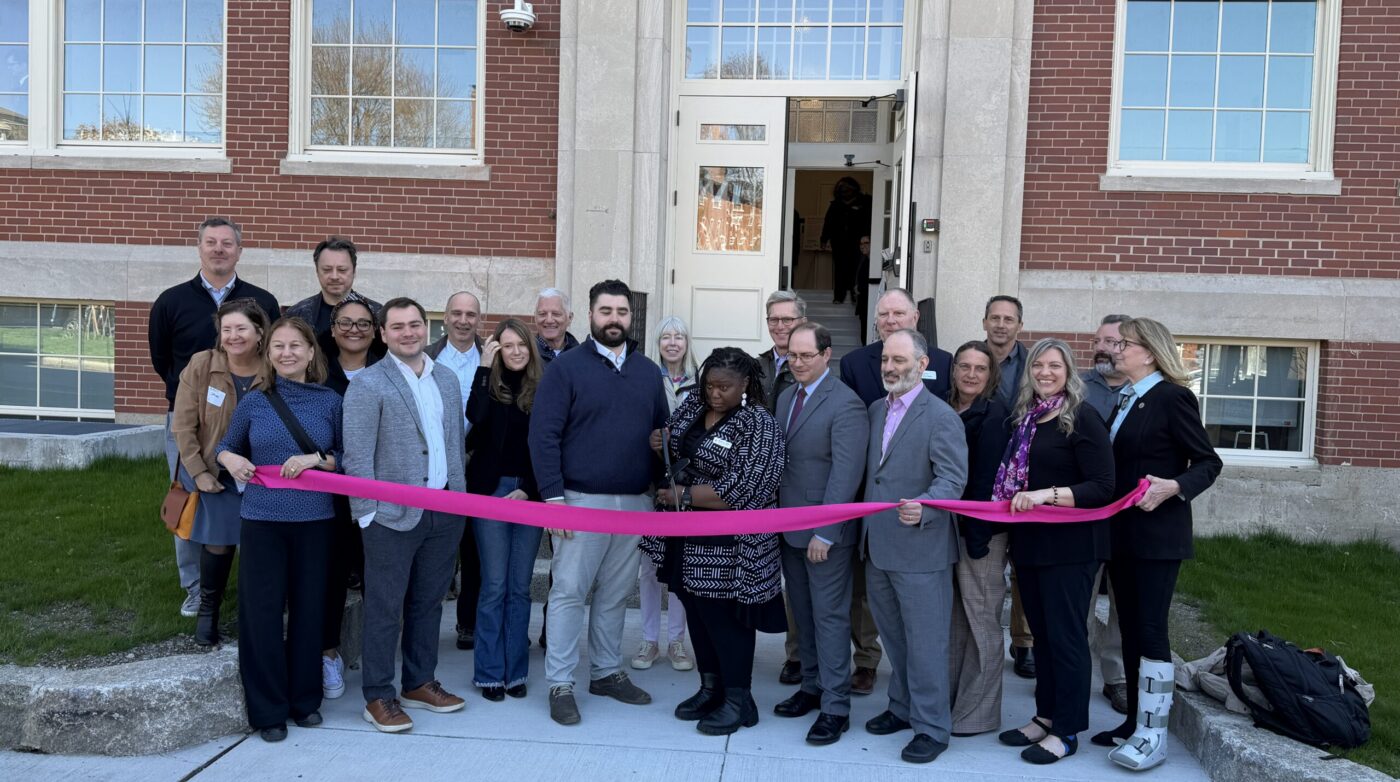
A converted school auditorium in downtown Salem held an unlikely cross-section of the affordable housing world this morning. A priest from the Archdiocese of Boston. A state senator. The director of the Punto Urban Art Museum. Affordable housing financiers. City planners. And Sarah Ashodian, the building’s first artist-resident. The occasion was the ribbon-cutting for Hawthorne Lofts, 29 units of affordable artist housing in Salem that took 8 years, 20 funding sources, and 19 public meetings to build. The project is the first half of the Salem Schools development — a sixty-one-unit adaptive reuse of two former parochial schools led by North Shore Community Development Coalition. What made the morning notable wasn’t the building. It was who showed up, and what they had built together.
Key Takeaways
- Hawthorne Lofts is twenty-nine units of affordable artist-preference housing at 13 Hawthorne Boulevard, Salem, in the former St. Mary’s School
- The building is the first half of the Salem Schools project, paired with the thirty-two-unit Residences at St. James for residents sixty-two and older, about a mile and a half away on Federal Street
- More than 1,600 households applied for the sixty-one affordable homes across both buildings
- The project required twenty funding sources, nineteen public meetings, two zoning filings, and nearly eight years
- The former auditorium is being converted into 5,000 square feet of artist studio space, designed in collaboration with the Punto Urban Art Museum based on artist input gathered in 2020 and 2021
What Hawthorne Lofts Means for Affordable Artist Housing in Salem
Hawthorne Lofts opens with twenty-nine apartments — seven studios, eighteen one-bedrooms, and four two-bedrooms — all affordable, all carrying a preference for artists. Together with Residences at St. James, the Salem Schools project will be home to roughly 90 people once both buildings are fully leased. Both were once parochial schools owned by the Archdiocese of Boston. St. Mary’s School, closed since the 1970s, is now Hawthorne Lofts. St. James School, closed since the 1980s, becomes a senior residence.
NSCDC CEO Felicia Pierce had the room say the application number out loud. Twice. More than 1,600 households for sixty-one homes. The number landed differently the second time.
How Does a Project With 20 Funders Actually Get Built?
Cross-sector collaboration in community development is constantly talked about. It almost never looks like what was in the room this morning.
Consider the partner stack. The Archdiocese of Boston didn’t just sell two empty schools. Father Robert Murray, pastor of Mary, Queen of the Apostles parish, helped frame the project from the start as a values commitment for the Archdiocese, not a real estate transaction. In 2019, the coalition entered into a ninety-nine-year ground lease with the Archdiocese for both properties.
The City of Salem didn’t just process permits. The Municipal and Religious Reuse special permit ordinance, passed by City Council in September 2019, created the legal pathway for former religious and municipal buildings to be converted into multifamily housing. Mayor Dominick Pangallo’s administration then carried the project across years of approvals to its October 2024 financial close.
Furthermore, the funders — MassHousing, CEDAC, the Executive Office of Housing and Livable Communities, TD Bank, Dorfman Capital, and fifteen others — each came with their own compliance requirements that had to coexist. Mark Teden, MassHousing’s Vice President of Multifamily Programs, described the work of making twenty separate sets of rules “knit together” so that no single funder ended up in conflict with another. That is not a transactional skill. It is a relational one.
Why Did the Auditorium Become Studios?
The most striking design choice at Hawthorne Lofts is what’s happening in the old school auditorium. Five thousand square feet of former assembly space is being converted into ten micro studios, two sound studios, an acoustic ceiling that controls echo, and a vertical lift providing full ADA access. Hand-woven curtains from an artisan in Pátzcuaro, Mexico, will hang in the space, sourced through Saniego Sanchez, Director of the Punto Urban Art Museum.
Every detail came from somewhere specific. In 2020 and 2021, NSCDC and the Punto Urban Art Museum surveyed local artists about what they actually needed in a live-work environment. Creative Collective helped circulate that outreach across Essex County’s North Shore. The amenities in the studio space trace back to those conversations.
Funding the studios required its own bridge. Mass Cultural Council’s Cultural Facilities Fund and MassDevelopment’s Collaborative Workspace Program filled gaps that conventional housing or cultural grants couldn’t cover alone. Jay Paget, Program Director at the Cultural Facilities Fund, summarized the structural problem the project had to solve: housing funders don’t do third spaces, and cultural funders don’t do housing. Someone had to build the bridge between those two worlds. It took a crew.

What Hawthorne Lofts Tells Us About the Creative Economy
The creative economy doesn’t thrive in isolation. Artists need affordable places to live and work. Developers need partners who understand artists’ needs. Cultural organizations need capital allies willing to engage with the housing finance sector. Municipalities have to be willing to sit through 19 public meetings to develop a shared vision.
When those relationships are real — when institutions are in genuine relationships rather than just operational proximity — projects like Hawthorne Lofts become possible. As part of Essex County’s business support ecosystem, Creative Collective has watched this version of cross-sector collaboration develop over the years. It is rare and instructive.
Sarah Ashodian, the building’s first resident, has been making art in Salem since 2005 and helped launch the city’s first open studios. She stood at the front of the room and called the project “really, really special.” Coming from someone who has watched Salem’s creative scene grow from the inside for two decades, that read as significant.
What Happens Next?
Soon, ninety people will be living between the two Salem Schools buildings. The studio space inside Hawthorne Lofts isn’t finished yet. Lottery applications closed in May 2025, and move-in is rolling. The full Salem Schools project is wrapping construction in 2026.
The building is open. The collaboration that built it isn’t done.
Frequently Asked Questions
What is Hawthorne Lofts?
Hawthorne Lofts is a twenty-nine-unit affordable rental building at 13 Hawthorne Boulevard in Salem, Massachusetts. It offers studios, one-bedroom, and two-bedroom apartments with a preference for artists. The building was developed by North Shore Community Development Coalition through the adaptive reuse of the former St. Mary’s parochial school.
Where is Hawthorne Lofts located?
Hawthorne Lofts is at 13 Hawthorne Boulevard in downtown Salem, MA, within walking distance of the Peabody Essex Museum, Pickering Wharf, the Punto Urban Art Museum, the Essex Pedestrian Mall, and the MBTA commuter rail station.
How many units does the Salem Schools project include?
The Salem Schools project includes sixty-one affordable units total. Twenty-nine are at Hawthorne Lofts (artist preference) and thirty-two are at Residences at St. James (sixty-two-and-older senior housing) at 160 Federal Street, about a mile and a half away.
Who funded Hawthorne Lofts?
The project pulled together twenty funding sources, including MassHousing, CEDAC, the Executive Office of Housing and Livable Communities, TD Bank, Dorfman Capital, Mass Cultural Council’s Cultural Facilities Fund, and MassDevelopment’s Collaborative Workspace Program. MassHousing closed on $22 million in financing for the full Salem Schools project in October 2024.
What is in the artist studio space?
The former school auditorium is being converted into 5,000 square feet of creative space, including ten micro studios, two sound studios, an acoustic ceiling, a vertical lift for full ADA access, and hand-woven curtains sourced through the Punto Urban Art Museum from an artisan in Pátzcuaro, Mexico.
This story comes from the Creative Collective community — Essex County businesses who believe when we thrive together, our whole region becomes more vibrant. We’re entrepreneurs, creators, and service providers across all industries, collaborating to build the community we want to be part of. If you see your business as more than just commerce — as a way to contribute to our regional ecosystem — you belong here. Discover how to join our community →

By John Andrews, Content Director at Creative Collective. John writes about regional business, cross-sector collaboration, and the creative economy across Essex County’s North Shore.
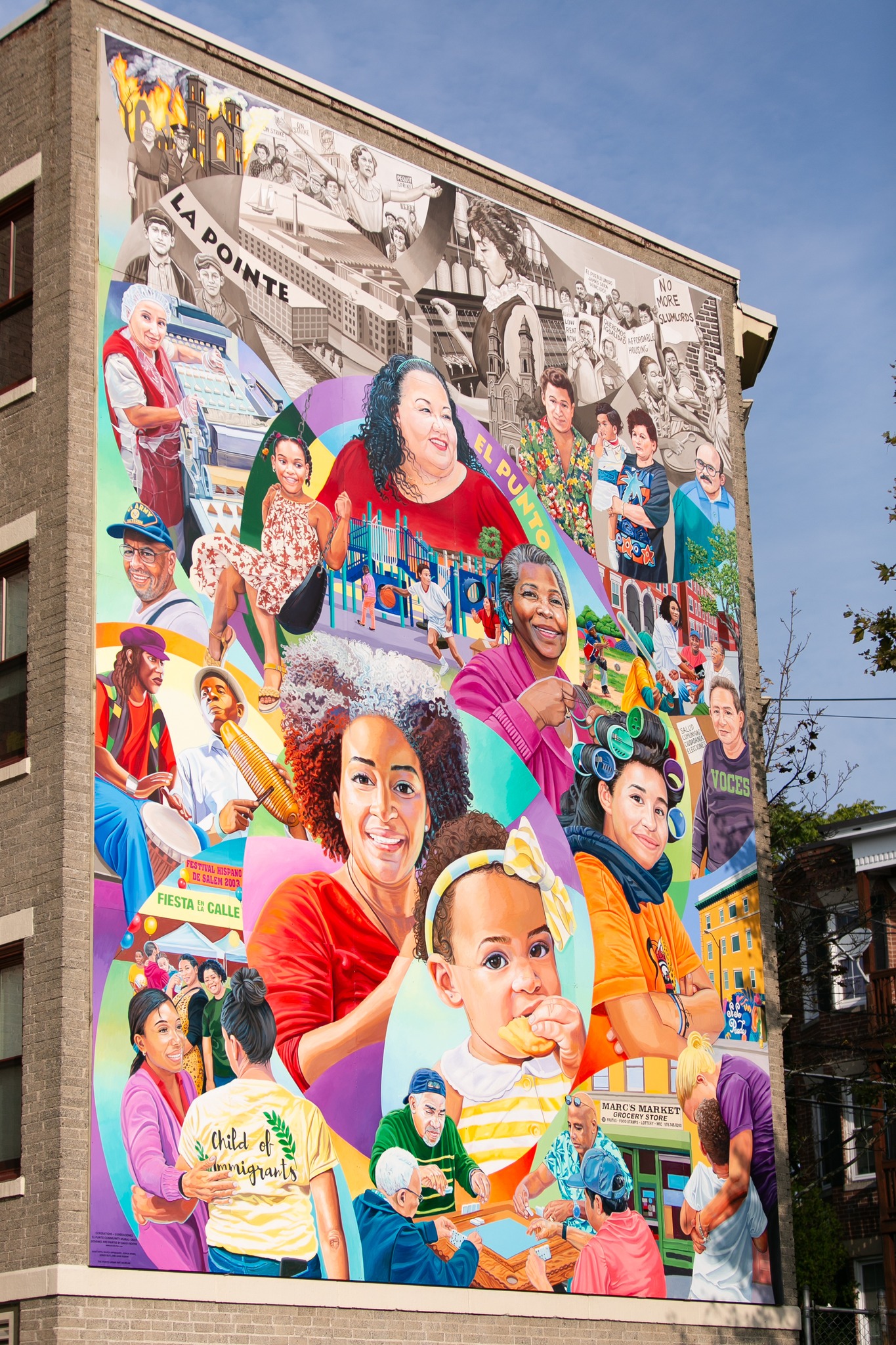
North Shore CDC
View their Member Listing
North Shore CDC invests in neighborhoods to create thriving communities. We envision a North Shore where every neighborhood is one of choice and opportunity. We use our community-focused development model to invest resources into low-income or distressed neighborhoods on the North Shore to improve the quality of life for residents. We are committed to the community through affordable housing, economic
SEE LISTING