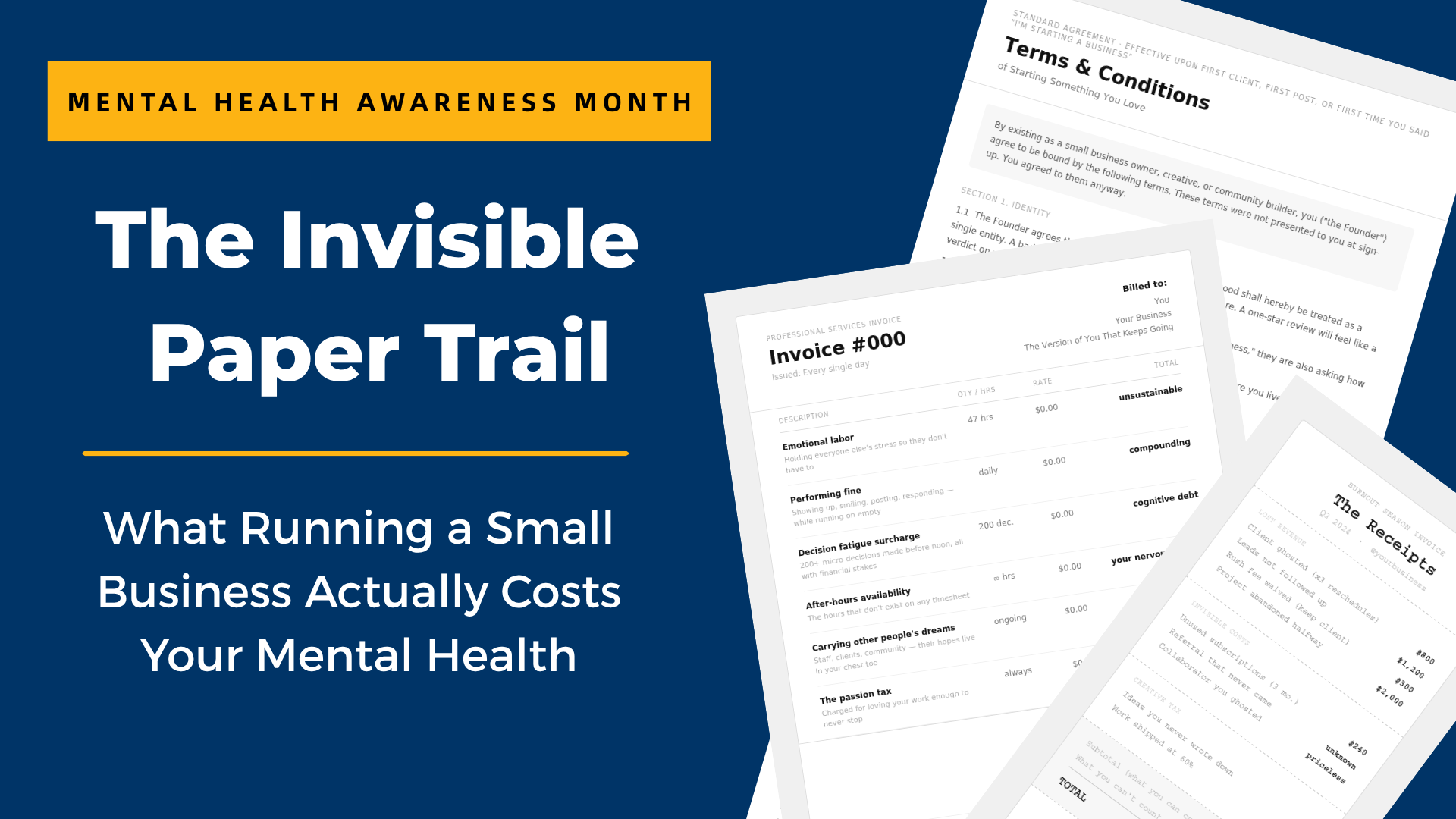
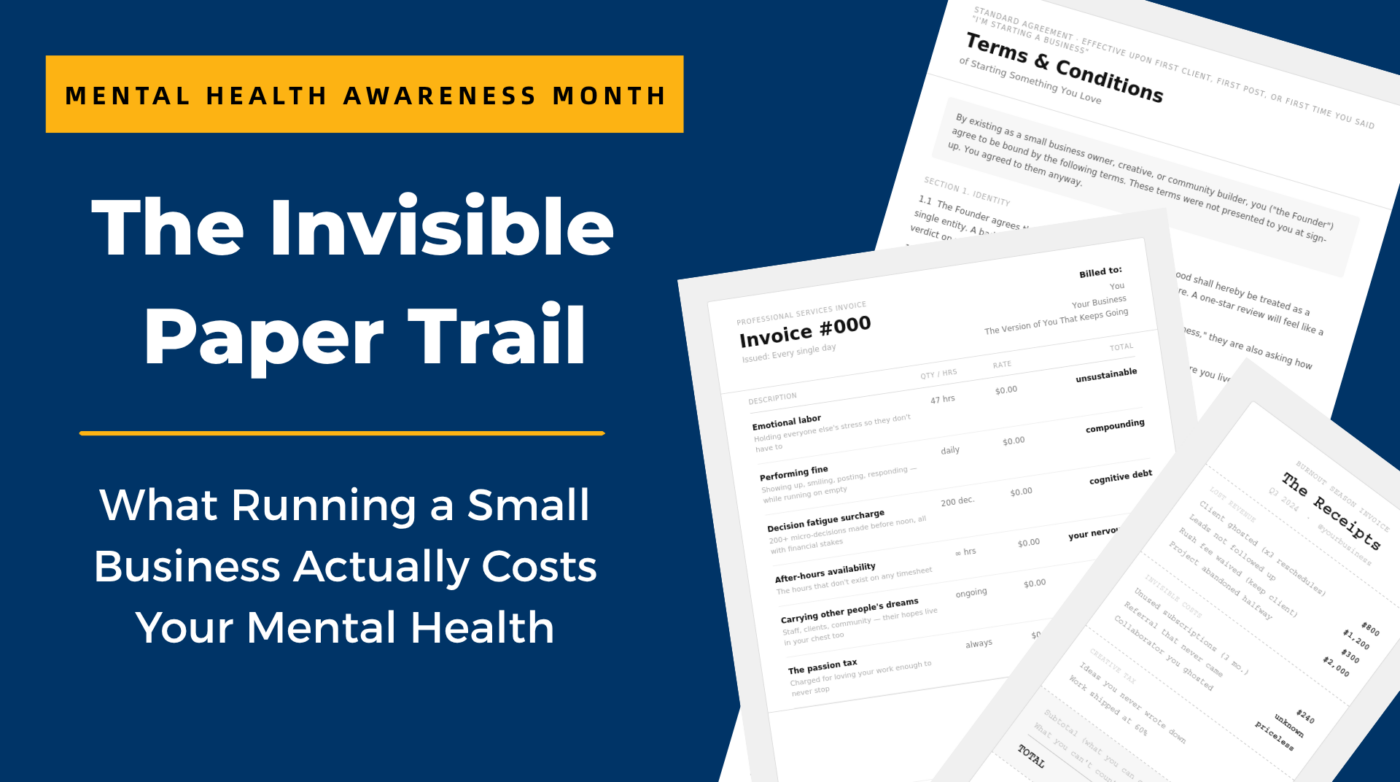
What Running a Small Business Actually Costs Your Mental Health
Nobody hands you a disclosure statement when you start a business. There’s no fine print warning you that your revenue month will feel like a verdict on your character, or that rest will start to feel like a risk you can’t afford. Mental Health Awareness Month tends to fill our feeds with reminders to take breaks and practice self-care (good advice, not wrong advice), but it rarely names what’s actually happening for the people building something from scratch. This is for those people. The ones who are fine, mostly, except when they’re not.
The agreement nobody told you about
When you started your business, you signed something you never got to read. It said your identity and your business would become the same entity. A slow month wouldn’t just feel like a cash flow problem, it would feel like a personal failure. A critical email wouldn’t just be feedback, it would feel like a verdict. Nobody told you this was part of the deal. Most of us figured it out somewhere around month six, usually alone, usually in the middle of a sleepless night, and definitely anxious.
This is one of the least-discussed mental health realities for small business owners and creatives: the merger of self and work is not a mindset problem. It is a structural one. When your business is your name, your idea, your reputation – there is no clean line between professional disappointment and personal pain. Recognizing that isn’t weakness. It’s just accurate.
Does this look familiar even though you’ve never seen it before? 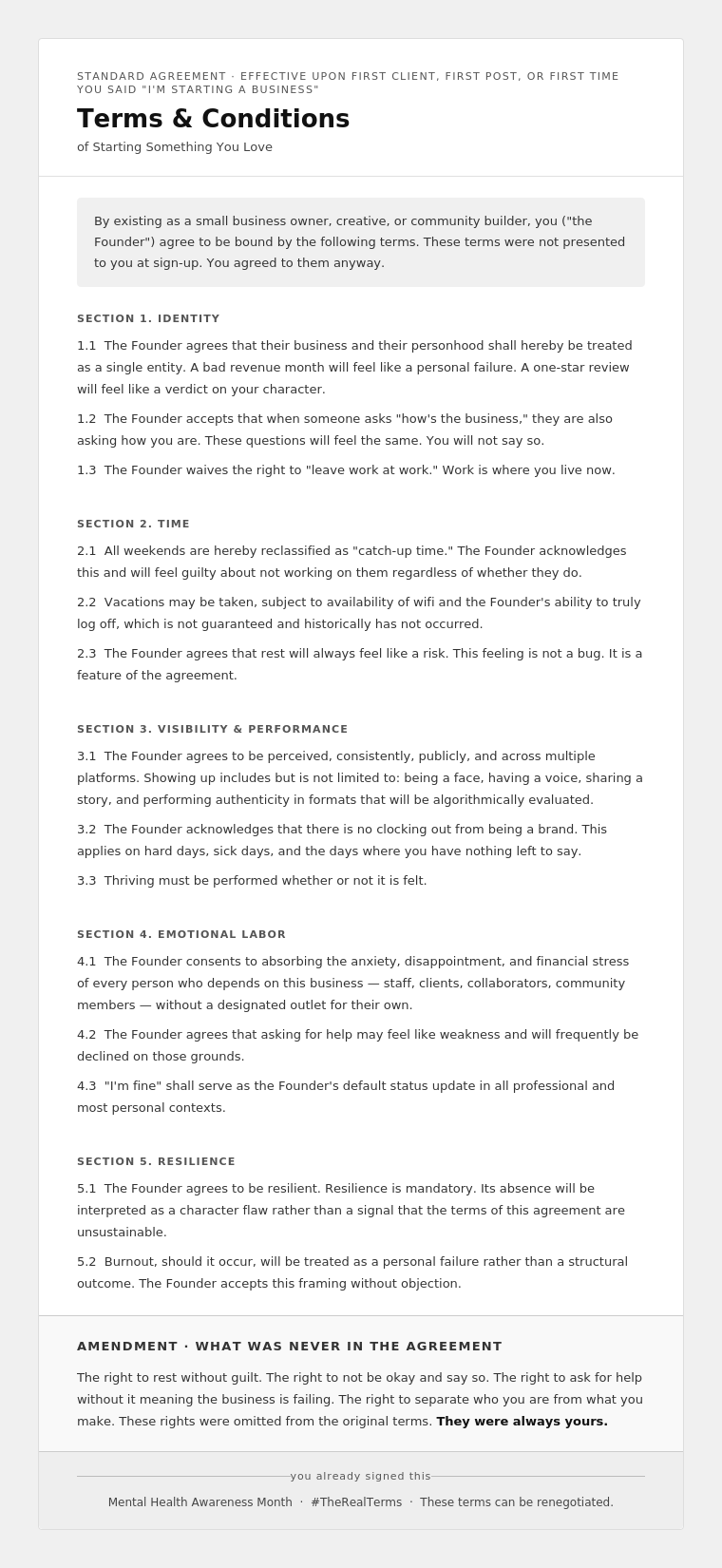
Why does success sometimes feel worse than struggle?
Here’s the thing nobody prepares you for: the wins can be just as destabilizing as the losses. A viral moment, a sold-out launch, a feature that brings in more inquiries than you can handle – these should feel like relief. Sometimes they do. And sometimes they bring a quiet panic that’s hard to explain to people outside your world.
Mental health conversations in entrepreneurship almost always center the struggle. The bootstrapping, the lean months, the near-misses. What goes unspoken is the identity vertigo that can follow success: the sudden pressure to maintain it, the fear that it was a fluke, the grief that comes when the thing you worked toward finally arrives and you’re too depleted to enjoy it. For creatives especially, there is also the particular loss of watching a coping mechanism become a revenue stream. The thing that used to restore you now has a deadline attached to it.
The loneliness hiding inside community
Many small business owners and creatives are surrounded by people (i.e. clients, collaborators, employees, community members) and still profoundly alone. Not because their relationships aren’t real, but because the specific weight they carry isn’t shared.
No one else in the room is lying awake doing the same math you are. No one else is absorbing the financial risk, holding the anxiety of the people who depend on you, and still showing up to make something worth showing up for. Small business communities are good at showing up. Events, referrals, collaborations, the group chat that actually gets used: the support is real and it matters. The creative and entrepreneurial communities in Essex County are genuinely connected and supportive, and even within that, there is a loneliness that belongs specifically to the person whose name is on the door. Naming it isn’t a complaint. It’s a starting point.
What is decision fatigue actually doing to you?
Small business owners make hundreds of decisions before noon (pricing, hiring, client communication, content, operations, etc.), many of them with real financial stakes and no one to consult. This is not a productivity problem. It is a physiological one.
The cortisol your body produces during a difficult client conversation is the same cortisol it produces in a threat response. Run that response dozens of times a day, every day, for years – and what you’re dealing with is not stress in the casual sense. It is a chronic low-grade activation of your nervous system that almost never fully resolves. The mental health field rarely addresses this specific experience, because it doesn’t fit neatly into standard frameworks built for different kinds of lives. But if you’ve ever finished a workday feeling hollowed out in a way that sleep doesn’t fix, this is likely part of why.
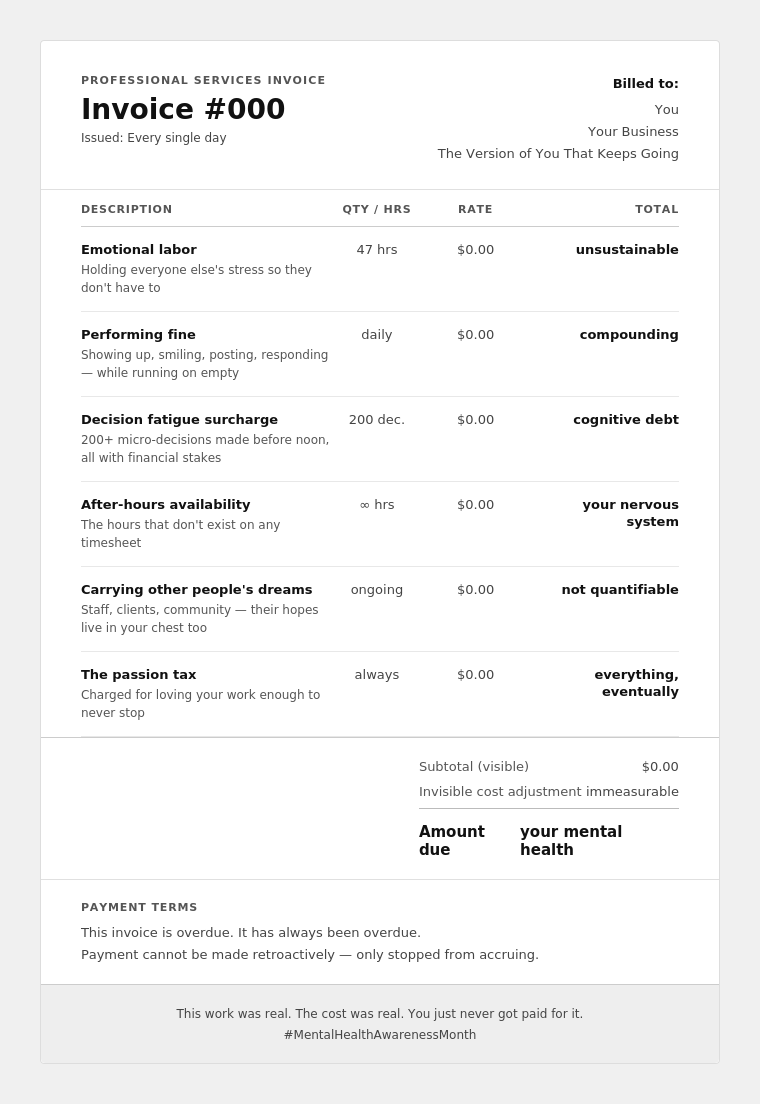
How do you talk about something that has no language yet?
Part of what makes mental health so hard to address in small business communities is that so much of the experience doesn’t have a name. There’s no clinical term for the emotional labor of carrying your employees’ livelihoods in your chest. There’s no widely recognized framework for what it costs to be your own brand: to be perceived, publicly, on hard days and sick days and the days you have absolutely nothing left to say.
The resilience culture that runs through entrepreneurial communities (i.e. the grit, the “figure it out,” the celebration of persistence, the hustle, etc.) is genuinely valuable. It’s also a barrier to help-seeking. When struggle is reframed as strength and burnout is treated as a character flaw rather than a structural outcome, people stop saying when they’re not okay. They perform thriving instead. And the performance, over time, costs more than the original problem.
What would it look like to renegotiate the terms?
The invisible agreement most small business owners signed doesn’t have to be permanent. The terms can change, though not all at once, and not without friction, but they can change. That starts with being honest, at least with yourself, about what the agreement has actually cost you.
Not the revenue you can point to, but the leads you didn’t follow up when you were too depleted. The collaborator you lost because you went quiet. The project you shipped at sixty percent because you had nothing left. The version of your work you haven’t been able to get back to. Those costs are real. They have a paper trail, even when they’re invisible on a balance sheet.
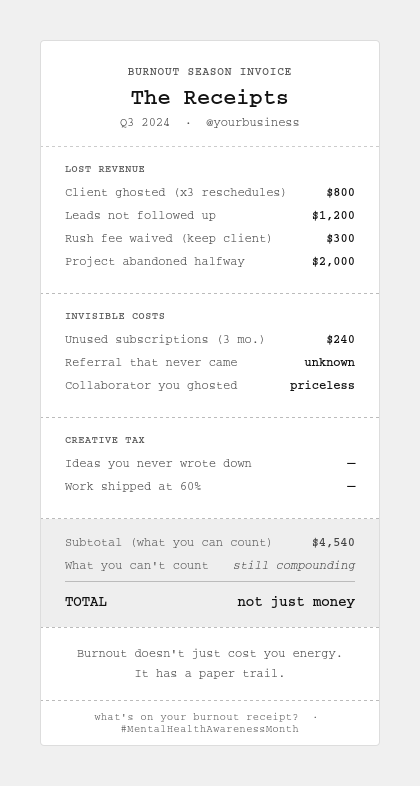
Mental Health Awareness Month is a useful prompt to stop and take stock — not of your self-care routine, but of the actual terms you’ve been living under. What did you agree to that you never consciously chose? What would you renegotiate if you knew you could? And who in your community do you trust enough to start that conversation with?
You don’t have to answer all of those at once. Starting with one is enough.
This one’s about you, not the business
The business you built came from something real. The drive, the vision, the willingness to put your name on something and show up for it every day — none of that is small. But the version of you that keeps the business going deserves the same attention you give the business. Not instead of the work. Alongside it.
Mental health in small business isn’t a wellness topic. It’s an operational one. The invisible costs compound the same way interest does — quietly, consistently, until the number is bigger than you expected. The difference is that this one you can actually do something about. Not all at once. Not perfectly. But you can start with what it’s actually cost you, say it out loud to someone who gets it, and go from there.
This story comes from the Creative Collective community
Essex County businesses who believe when we thrive together, our whole region becomes more vibrant. We’re entrepreneurs, creators, and service providers across all industries, collaborating to build the community we want to be part of. If you see your business as more than just commerce — as a way to contribute to our regional ecosystem — you belong here. Discover how to join our community →