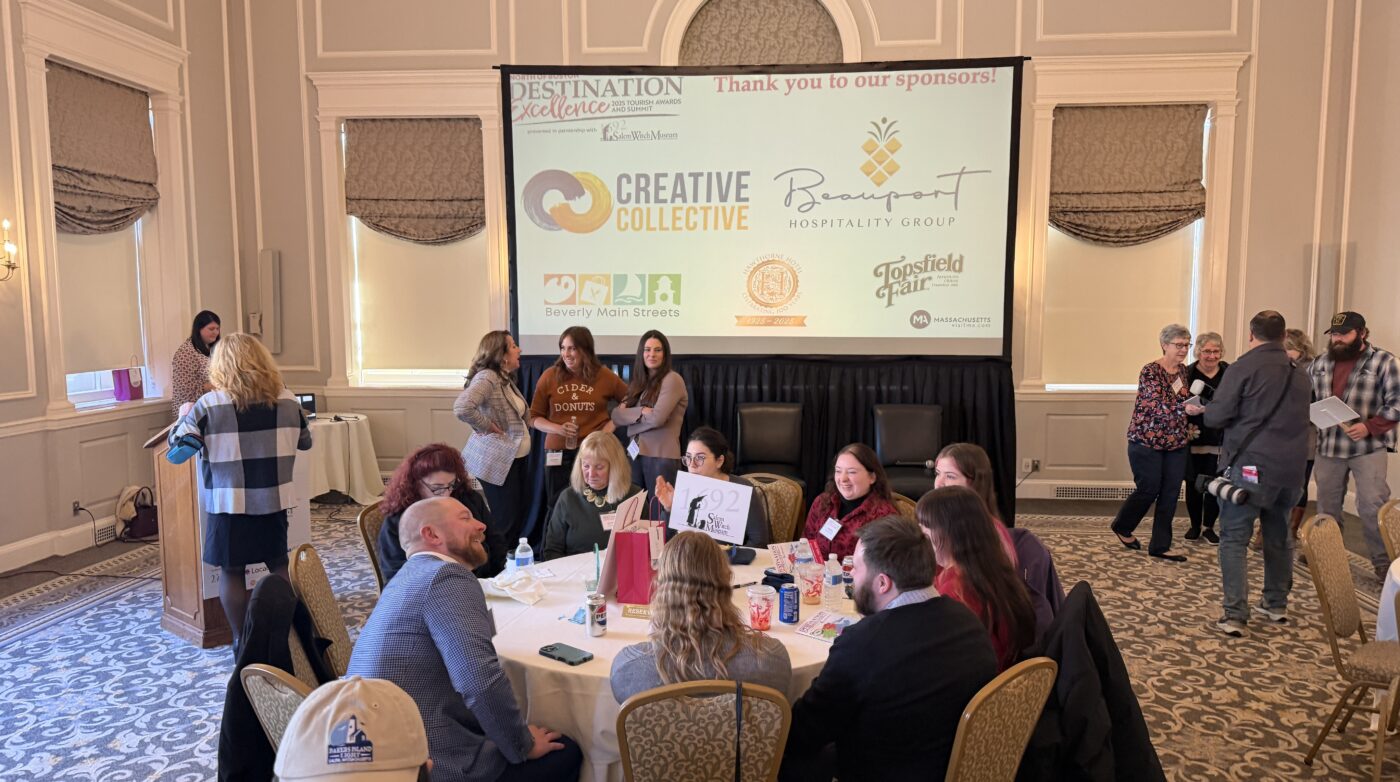
The North of Boston tourism awards Destination Excellence Summit gathered more than 200 professionals at Salem’s Hawthorne Hotel on November 19 to address a critical question: how does a region coordinate tourism strategy across 34 cities and towns while maintaining authentic local character? The timing proved symbolic—the Hawthorne Hotel celebrated its 100th birthday while hosting discussions about the next century of regional hospitality.
We attended as sponsors, grateful to see several Creative Collective members in the room alongside chamber directors, small business owners, state officials, and hospitality workers. However, the day’s significance extended far beyond any single organization. This summit examined how Essex County’s $1.2 billion tourism economy can grow sustainably through strategic collaboration rather than competition.
Tourism Economic Impact Drives Regional Employment and Tax Revenue
Lieutenant Governor Kim Driscoll opened the North of Boston tourism awards summit by framing tourism as one of Massachusetts’ strongest economic sectors. The numbers substantiate this claim. Essex County tourism generates over $1.2 billion annually in visitor spending, supporting more than 10,400 jobs while producing $107 million in tax revenue. These figures represent the real impact on families and small businesses throughout the North Shore.

Senator Joan Lovely, Mass. Office of Travel and Tourism Director Kate Fox and North of Boston CVB director Nancy Gardella
Salem’s statistics particularly demonstrate tourism’s concentrated power. Mayor Dominick Pangallo noted that 3.5 million visitors annually travel to this city of just 45,000 residents, creating $140 million in direct economic impact. Furthermore, one in every 25 jobs in Salem derives from tourism. State Representative Manny Cruz emphasized the human dimension behind these numbers—the 1,200 tourism jobs in Salem represent real neighbors, including servers, bartenders, housekeeping staff, and tour guides whose families depend on strong visitor numbers.
Nancy Gardella, Executive Director of the North of Boston Convention & Visitors Bureau, highlighted how coordinated marketing efforts ensure tourism dollars flow to communities year-round rather than concentrating in peak seasons. The CVB’s work marketing 34 cities and towns as premier travel destinations creates economic stability for hospitality workers who need consistent employment beyond October’s Halloween crowds.
Kate Fox, Executive Director of the Massachusetts Office of Travel and Tourism, announced that MOTT is returning to group travel marketing after a ten-year hiatus. Additionally, they’re launching sports marketing initiatives and expanding international outreach. The 2026 Massachusetts Semi-Quincentennial celebration will bring major promotional opportunities, positioning Essex County’s Revolutionary War heritage sites perfectly for growth.
Digital Marketing Transformation Requires Strategic Adaptation
The North of Boston tourism awards summit delivered actionable insights on how dramatically digital discovery has changed. Ray St. Amand from Sperling Interactive explained that “search everywhere” has replaced traditional Google searches. Travelers now use TikTok, Instagram, ChatGPT, and AI overview results to plan trips, fundamentally altering how businesses must approach online visibility.
St. Amand revealed that 60% of mobile searches now end without clicking to a website. This “zero-click” trend means structured data, schema markup, and consistent business information across all platforms become critical. Moreover, hotels and attractions must optimize for conversational search queries rather than just keywords. His workshop covered building custom GPTs for tourism businesses, which can assist with market research, content planning, and pricing audits.
Sarah Boucher from Bramble Hospitality shared essential insights on reaching younger travelers during the North of Boston Tourism Awards sessions. McKinsey research shows Gen Z plans 92% of trips using social media. However, this generation values authenticity over polish—unpolished, spontaneous videos consistently outperform heavily edited productions. Boucher demonstrated how Briar Barn Inn uses Instagram collaborations with local businesses to reach thousands of people organically, proving that partnerships amplify reach while reducing marketing costs.
Angela Prout and Marnely Murray from Shored Up Digital reinforced these themes by sharing potential collaborations, such as silent book clubs pairing hotels with local bookstores, or Hammond Castle Museum partnering with theater companies for historical reenactments. Their “Grounded Growth Philosophy” emphasizes authentic storytelling over competition, recognizing that local businesses become stronger brand ambassadors when they support each other.
Collaboration Framework Emerges as Competitive Advantage
The North of Boston tourism awards programming consistently returned to one theme: collaboration beats competition when building thriving destinations. Senator Joan Lovely illustrated this transformation by recalling that twenty-five years ago, Salem’s Washington Street was so empty that local journalists joked about shooting cannonballs down it without hitting anyone. Today, Salem welcomes 3.5 million annual visitors. This dramatic change resulted from strategic destination marketing partnerships between the CVB and city leadership.
Several award recipients exemplified the power of collaboration. Beverly Main Streets, led by Erin Truex and Becki Greene, won the New Member award for creating an arts district that honors history while embracing innovation. Beverly’s recognition as America’s highest livable ZIP code for 2025 came from years of intentional community building—one Arts Fest and one Ellis Square improvement at a time. Their model demonstrates how downtown revitalization succeeds when multiple stakeholders coordinate rather than compete.
Similarly, 7 Seas Whale Watch won the Small Business Award partly for its exceptional social media, which promotes the entire North Shore region rather than just its own tours. Their daily trip updates reach thousands of people each week, benefiting all area businesses by building regional awareness. This approach recognizes that visitors who come for whale watching also need restaurants, hotels, and additional attractions—rising tides truly lift all boats.

Sarah Boucher of Bramble Hospitality Group
Karen Nascembeni received the Anne Turcotte Leadership Award for embodying a philosophy of “always offering to host or help first.” This proactive approach to creating space for others to thrive captures something essential about successful regional tourism development. Instead of waiting to be asked, effective destination marketing organizations anticipate needs and build collaborative frameworks.
Award Recipients Demonstrate Service Excellence and Innovation
The North of Boston tourism awards ceremony recognized organizations that exemplify how quality experiences drive repeat visitation. Salem Witch Museum received the Storyteller Award for 50 years of teaching about mass hysteria and persecution dangers. Their education team goes beyond simple tours—Jill researches property maps to locate 1692 sites, Rachel builds artifact collections, Johnson partners with universities to understand visitor patterns. This approach treats tourism as education and civic responsibility rather than mere transaction.
The Hawthorne Hotel’s Geoff Woodman Hospitality Award recognition highlighted another critical theme: excellence requires every team member’s contribution. General Manager Claire Kalellis spoke about custodians who make rooms sparkle, bellhops who carry more than luggage, and dishwashers who keep kitchens humming. Significantly, she noted the hotel was built in 1925 through community subscription fundraising, creating a parallel to today’s collaborative spirit. Salem has always been a place that shows up for itself.
Sheila Beach from Amesbury Chamber of Commerce won the inaugural Emerging Leader Award for innovative networking events featuring goat yoga, karaoke, and comedy alongside traditional business programming. She also launched the Explore Amesbury app and publishes “The Local Merchant” newspaper. These creative approaches build engaged business communities that can better coordinate tourism messaging and visitor experiences.
Ashley Godjikian from Cider Hill Farm won the Frontline Hospitality Award, with her manager noting that Ashley once raced to open a second register so customers wouldn’t wait one extra second. This dedication to service creates the welcoming atmosphere that keeps visitors returning to the North Shore. Small touches matter tremendously in hospitality excellence.
Strategic Opportunities Position Region for Sustainable Growth

Congratulations to the team at the Hawthorne Hotel for celebrating 100 years!
The North of Boston tourism awards summit concluded with optimism about balancing growth with sustainability. Rather than focusing exclusively on October’s Halloween crowds, workshop discussions emphasized attracting visitors year-round through winter festivals, spring cultural events, and summer outdoor recreation. This balanced approach supports hospitality workers with consistent employment while reducing strain on infrastructure during peak seasons.
The 2026 Massachusetts 250th anniversary celebration represents a once-in-a-lifetime marketing opportunity. Revolutionary War heritage sites throughout Essex County will benefit from statewide campaigns driving significant visitor interest. However, several speakers cautioned that sustainable growth requires infrastructure investment and workforce development alongside marketing initiatives.
Digital innovation emerged as both an opportunity and a challenge. While AI-powered marketing tools and social media strategies offer cost-effective reach, they also require staff training and strategic adaptation. The North of Boston tourism awards workshops provided practical frameworks, but implementing these strategies demands ongoing investment in professional development.
Most importantly, the summit reinforced that regional competitiveness depends on coordination rather than individual excellence alone. When Beverly thrives, Salem benefits. When Amesbury innovates, Newburyport gains insights. The North of Boston tourism awards celebrated this interconnected reality, providing both recognition for past achievements and tools for collaborative future success.
This story comes from the Creative Collective community – Essex County businesses who believe that when we thrive together, our whole region becomes more vibrant. We’re entrepreneurs, creators, and service providers across all industries, collaborating to build the community we want to be part of. If you see your business as more than just commerce – as a way to contribute to our regional ecosystem – you belong here. Discover how to join our community →

North of Boston Convention & Visitors Bureau
View their Member Listing
The North of Boston Convention and Visitors Bureau, Inc. North of Boston Convention and Visitors Bureau (NBCVB) The North of Boston Convention and Visitors Bureau (NBCVB) is a private, nonprofit organization established in 1955 to promote Essex County as a premier travel destination. As one of Massachusetts’ 16 regional tourism councils, NBCVB serves as the official liaison between the North
SEE LISTING