By John Andrews, Creative Collective MA
Journee LaFond stood in front of a sold-out theater in Salem on Transgender Day of Visibility. She said, “I am planting the seeds of a forest that I’m not gonna see.”
That was Day One of GRAYSCALE. There were still two days left, and already, the atmosphere felt transformed.
I wrote the first version of this piece before the summit happened. It was a data argument. The numbers prove Salem’s gothic, alternative, and indie business community is a REAL economic force, not a seasonal curiosity. That argument still holds. Every number I cited is still true.
But after three days in a room with over seventy speakers and a sold-out crowd from fifteen states, I watched that thesis come alive in ways the data couldn’t predict. The numbers signaled importance; the summit revealed its meaning. This version keeps the numbers, but now adds the stories behind them.
A $1.4 Billion Industry That Just Filled a Theater
The U.S. gothic fashion industry was valued at $1.4 billion in 2022 and is projected to reach $2.3 billion by 2032. Nationally, arts and culture contribute $1.2 trillion to GDP—4.2% of the entire U.S. economy—and support 5.4 million jobs. In Massachusetts alone, the creative economy adds $29.7 billion in economic value and employs more than 130,000 people. That’s second among ALL sectors in value added—ahead of construction and transportation. The sector grew at more than twice the rate of the overall economy between 2022 and 2023.
I’ve been citing those numbers for months. Yet economic development agencies keep focusing on sectors like biotech and AI, overlooking indie retailers who employ six people and drive foot traffic in their neighborhoods.
Then GRAYSCALE happened — and it didn’t come out of nowhere. Years ago, Amber Newberry, founder of Die with Your Boots On, ran a market called Daughters of Darkness and had planned to add panels and discussions just like these. Ten days before it was set to kick off — vendors stocked, programming ready — the pandemic shut it down. That file of discussion topics sat on her computer for years. She stumbled over it a couple of months before GRAYSCALE and decided it was time. Three months of planning. A concept she’d been carrying since before COVID. And the DWYBO team filled Cinema Salem to capacity, drew attendees from fifteen states, and programmed twenty-three sessions that were more honest, more tactical, and more transformative than any corporate conference I’ve attended in fifteen years of doing this work.
This wasn’t merely a personal observation; it was a clear market signal, demonstrated in real time.
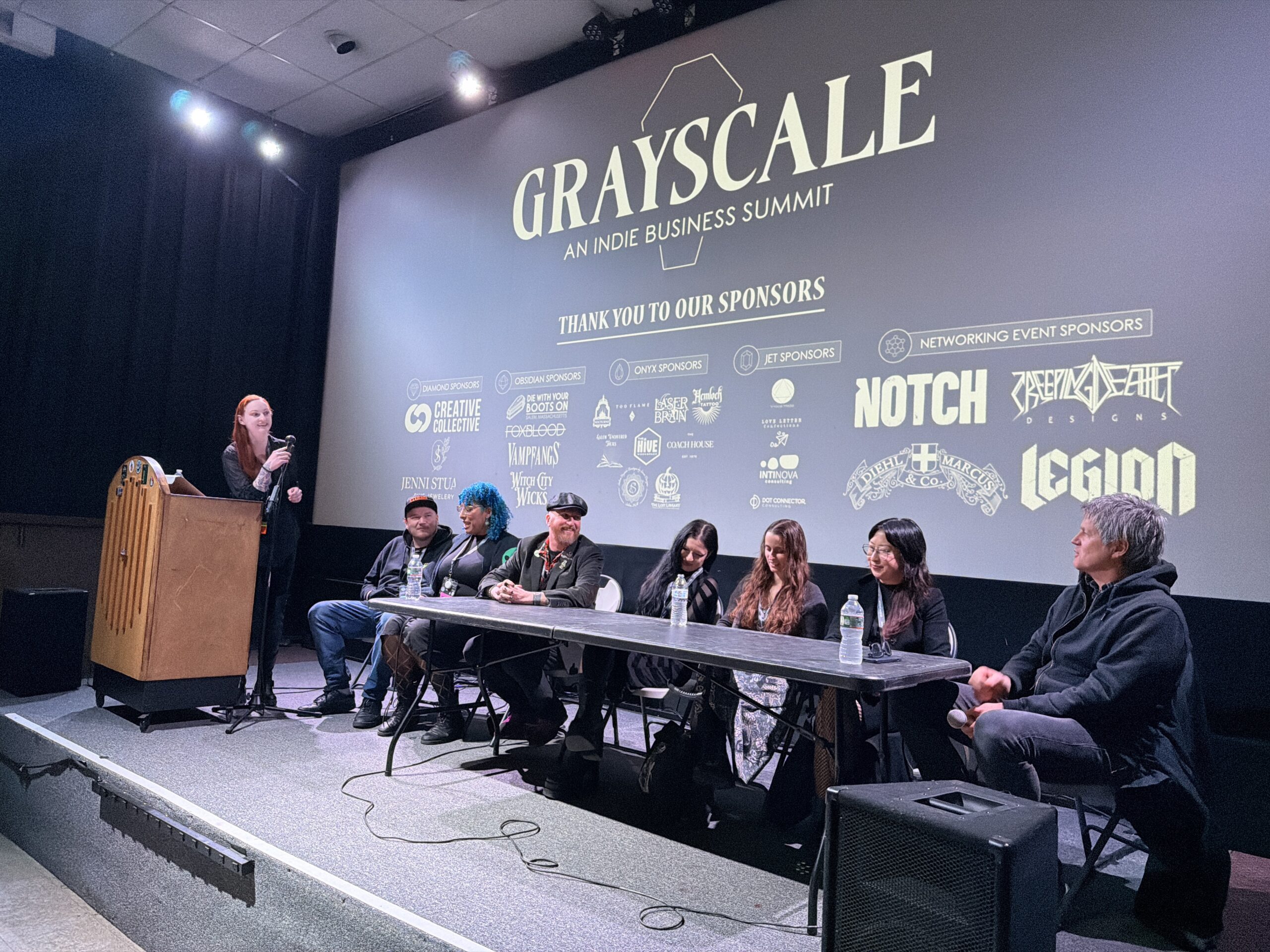
The ‘Brand Without Compromise: Brand Identity and Staying True to Your Vision’ panel in session at the Grayscale Indie Business Summit at Cinema Salem in Salem, MA. Panelists: Melissa Woods (Trued Apparel), Chris Lohring (Notch Brewing), Ana Campos (Circle of Stitches), Tianna Taylor, Tom Gonzalez (Eternal October), Jeff Lilley (Salem Uncovered Tours). Moderated by Amber Newberry (Die With Your Boots On).
What the Room Proved
Every panel at GRAYSCALE reinforced the same economic reality from a different angle. This is what the data looks like when real people are living it.
For every $100 spent at an independent local business, $68 stays in the community. At a national chain? $43. Independent retailers create 57 jobs for every $10 million in sales. Large chains create 14. On the Rise, Rebirth & Revitalization of Main Street panel, Meg Wasmer from Copper Dog Books told the story of Root and Oak & Moss—owners who ran three separate businesses in downtown Beverly specifically to create walkability. They transformed an entire downtown and made the surrounding businesses viable. That’s not just entrepreneurship. That’s civic construction. And it’s exactly the local multiplier effect the data describes, happening right here on the North Shore.
Salem’s tourism industry generates $144 million annually and supports over 1,200 jobs. It draws more than a million visitors to downtown in October alone. But what draws them? Not a convention center. The independent shops. The weird ones. The ones with personality. Die With Your Boots On, VampFangs, Witch City Wicks, Nocturne, Hive & Forge, and The Black Veil—these businesses are open year-round, locally owned, and employ their neighbors. The ecosystem doesn’t stop at the alternative shops. Businesses like Jenni Stuart Fine Jewelry, Wicked Good Books, and the Peabody Essex Museum aren’t goth businesses — but they’ve recognized the value of this community and found ways to welcome and serve (and support) it alongside their broader audiences. That’s not riding a wave. That’s reading the room. And when businesses across different sectors start doing that, the whole downtown gets stronger.
I said something in my opening keynote at GRAYSCALE that I meant with every fiber of my being: independent businesses are civic infrastructure. When an indie business closes, something irreplaceable goes with it. Not just a storefront. A gathering space. A person’s livelihood. A piece of what makes a place Salem. These aren’t shops. They’re the reason people feel something when they walk down Essex Street.
At the Salem Roundup panel, those shop owners got candid about the real threat: outside money and corporate encroachment, pricing local businesses out of the very downtown they made worth visiting. Liz Frazier from Witch City Wicks said what everyone has been thinking—rising lease competition could displace the businesses that made Salem what it is. That should keep policymakers up at night. It keeps me up at night.
And on the commerce side? TikTok Shop generated $33.2 billion in global sales in 2024. It has 171,000 U.S. small businesses on the platform. Live selling converts at 8–12%, compared to 2–4% for traditional e-commerce. At the F*ck It, We’ll Do It Live panel, Lindsay Hearts and the FOXBLOOD team showed exactly how that works—TikTok Shop integrated with Shopify, consistent scheduling, and a community that builds as you learn together. These businesses aren’t watching the future of retail from the sidelines. They’re building it.
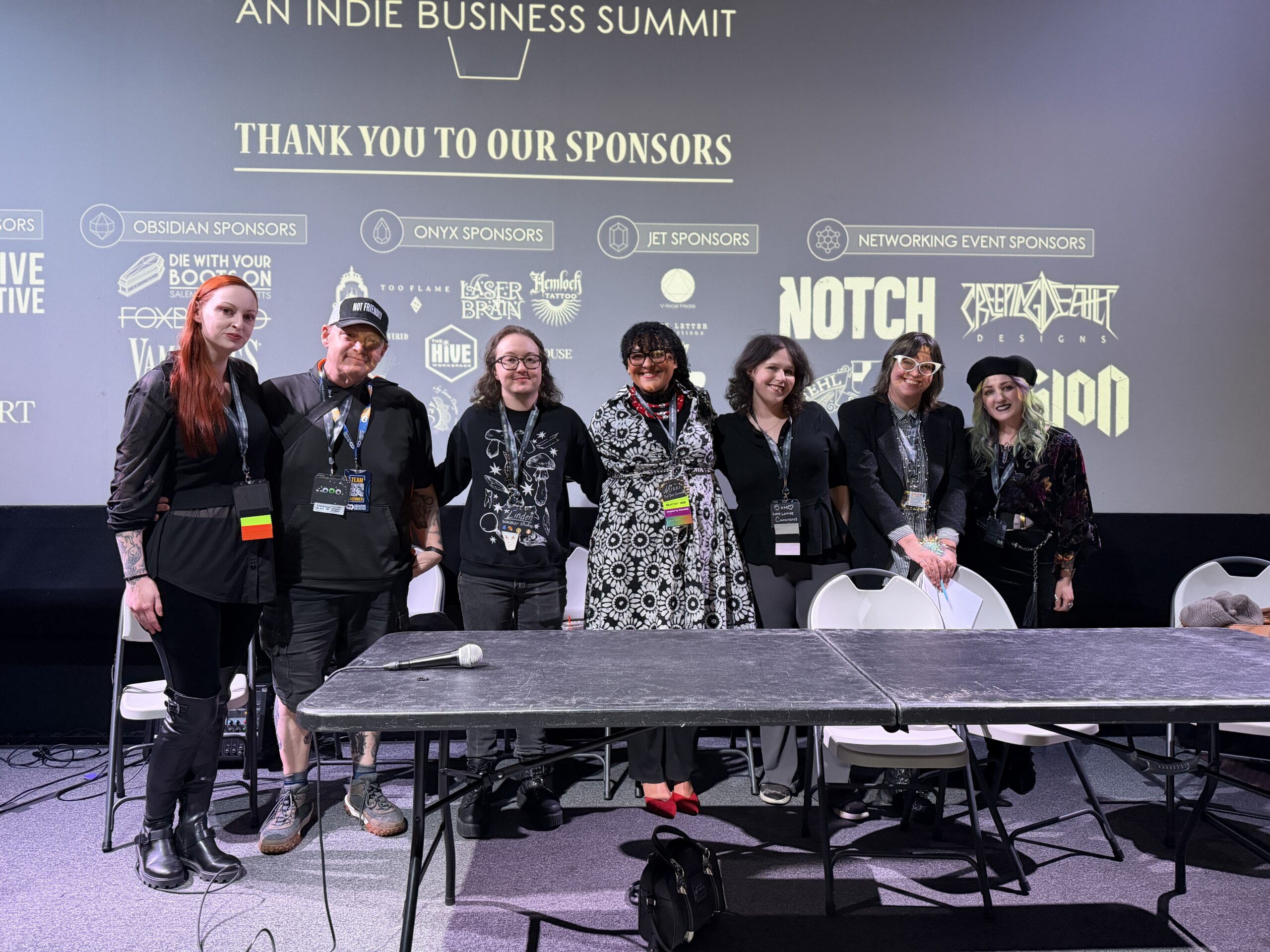
Speakers from the ‘Making it Count: Arts and Outreach in Your Main Street Community’ panel pose for a group photo at the Grayscale Indie Business Summit at Cinema Salem in Salem, MA. Pictured are John Andrews (Creative Collective), Elise Towle Snow (Salem Main Streets), Mikki L. Wilson (Dot Connector Consulting), Linden Walker (Linden Walker Studios), Angie Parise (Open CasketVintage), and Samantha Laverdiere (Love Letter Confections). Moderated by Amber Newberry (Die With Your Boots On).
The Part the Data Can’t Capture
The economic argument is necessary. But it’s not the whole story. Because behind every one of those numbers is a person who built something no one else would.
Crystal started Health Goth Yoga because after fourteen years of practicing yoga, she’d never seen another tattooed, queer, bigger-bodied Latina instructor. Manny Rachana created Heart Lynx—permanent jewelry adapted for people with arthritis and cancer patients whose wrists are too frail for traditional clasps. Virginia from Witch Bitch Thrift built a community-funded trade-in system that has sustained free clothing access for 2 years. Amber described customers trying on gender-affirming clothes at DWYBO for the first time.
Every one of them built a business because they lived the gap. They couldn’t find what they needed, so they made it. That’s not advocacy as a brand strategy. That’s solving a real problem — and it’s the kind of economic activity that never makes it into the reports.
And these businesses don’t just face the normal challenges. On the Brand Without Compromise panel, Sammitery from Neverwhere canceled and refunded an order from someone who sent a hateful DM — because not all money is good money. Ana Campos from Circle of Stitches got Bible passages posted on her Facebook page for teaching tarot at a yarn shop. She kept going. Tianna Taylor from Eternal October spoke about being constantly the only Black person in the room at markets and in Salem’s alternative scene. Her words were extremely powerful and indicative of some of the challenging themes and discussions that emerged from the expo.
These aren’t soft stories. These are the operating conditions of a billion-dollar sector — and the people building it just keep showing up, even though they may be misunderstood and underestimated.
Nobody Has It Figured Out. That’s the Point.
Here’s where GRAYSCALE diverged from every business conference I’ve ever been to. It made room for the human behind the business.
On the Making the Most of It panel, Gladys Muñoz of Intinova Consulting, gave everyone in the room permission to have potato days—days where you just rest, without guilt, because you’re not lazy. You’re recharging. Mikki Wilson told the room flat out: the shame around needing help is what kills most small businesses. Katie Kimball Dyer, a financial advisor, said she has no financial minimum for clients. Just a personality minimum. You don’t need six figures to get professional help. You need to ask.
That hit hard for many people. Including me.
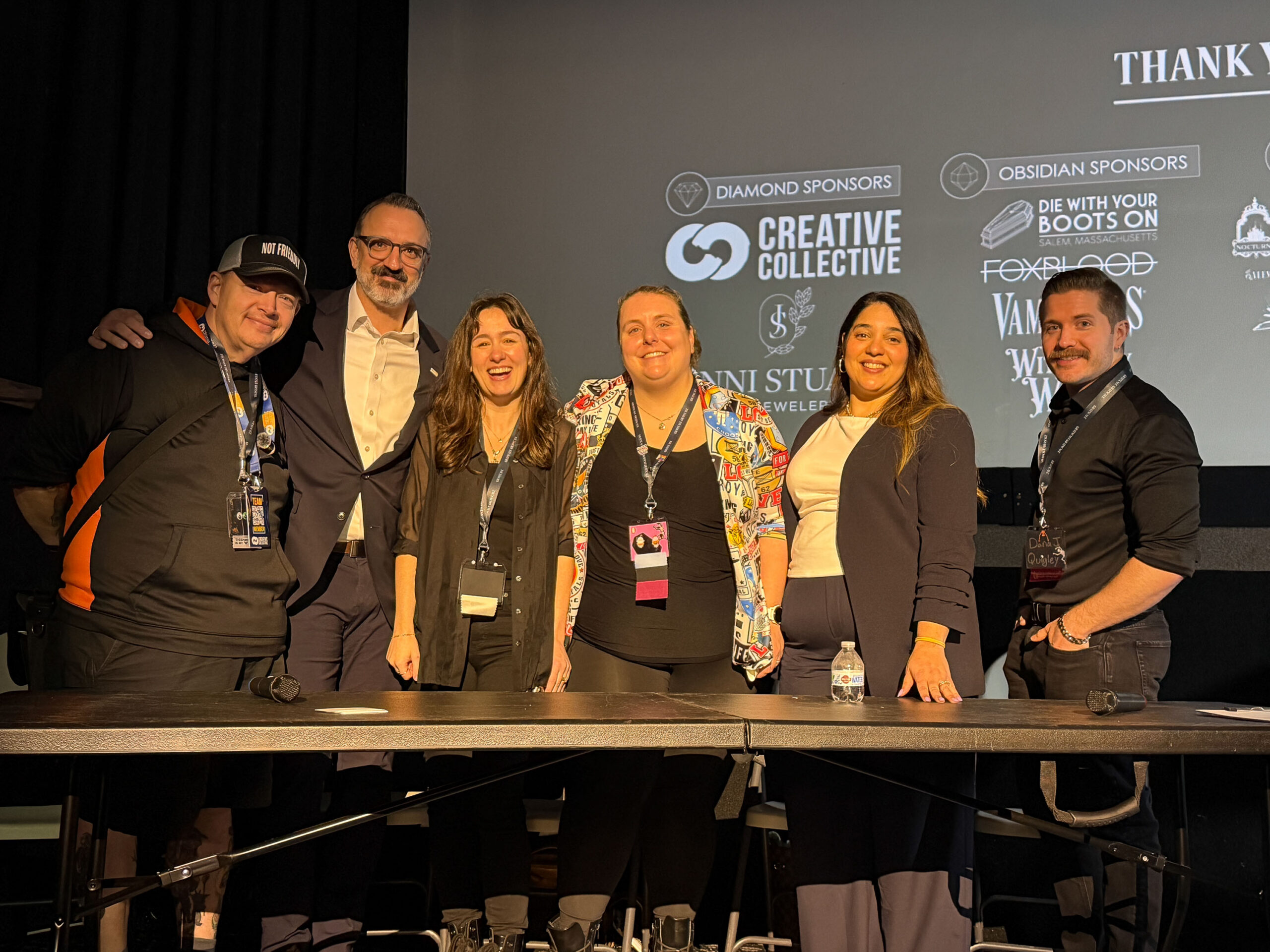
Panelists from the ‘Financing Your Dreams: Finding Funding, Managing Your Budget and Ensuring You Don’t Lose Your Shirt’ panel pose for a group photo at the Grayscale Indie Business Summit at Cinema Salem in Salem, MA. Pictured: Katie Kimball Dyer (Independent Financial Advisor), John Andrews (Creative Collective), Jenni Stuart (Jenni Stuart Fine Jewelry), Stephanie Hernis Rico (ASH Financial Group), and Jason Consalvo (Salem Five Bank). Moderated by Dana J. Quigley (DJQ Media).
On Balking the Burnout, Ash Nunez of Old Growth Alchemy, shared how algorithm-dependent Instagram traction crashed their mental health, and they had to disengage as a health boundary—not a failure, a boundary. Linden Walker introduced the Copenhagen Blue Book, a sketchbook project with no monetization attached. Just creative joy. Just the act of making something because it feeds you, not because it feeds the algorithm. And the panel landed somewhere I want every creative entrepreneur to hear: you have the power to fix yourself, sometimes with help from people who love you. That’s not a weakness. That’s wisdom.
And on All Are Welcome, Sylvan—who is multiply disabled and works at two community businesses—told the room to design spaces that are the OPPOSITE of sensory-overwhelming retail. That one sentence rewired my brain. The entire panel demonstrated that accessibility systems designed for disabled customers benefit everyone. That’s not a cost center. That’s a design philosophy. And it’s the kind of insight that only emerges when you build a conference where people can show up as their whole selves.
This is the essence of whole-person support. Business doesn’t occur in isolation. The person running the shop is the same person handling burnout, identity, and the challenges of an unsupportive world. GRAYSCALE made space for all of that. As a result, the business advice was better.
Your Network Is Your Most Valuable Tool
One thing struck me across all three days. The panelists learned from EACH OTHER—not from consultants or courses, but from peers who’d been through it. That’s the model. That’s what we see every day at Creative Collective with our diverse and unique members. Our members learn from each other. Peer expertise is the most undervalued asset in indie business.
Ryn Grant from The Castle uses her established platform to spotlight smaller businesses—not as charity, but as part of a business ecology. She said it plainly: collaborations are mutually beneficial in a capitalist sense, and business owners shouldn’t be afraid to say so. Heather Behera highlighted DWYBO’s consignment model, where almost all employees sell their own art in the store—an ecosystem that supports artists who can’t afford their own storefront. That’s not just retail. That’s infrastructure.
On the Out of the Closet panel—which landed on Transgender Day of Visibility—Ilan Kapra from Queer Videography said that if they were naming the company today, they wouldn’t put “queer” in the name. Because of fascism. The room didn’t flinch. And what followed was an honest, peer-to-peer conversation about strategic visibility, code-switching, and building sustainable businesses in hostile environments. That conversation doesn’t happen at a corporate conference. It happens when people trust the room they’re in.
Lindsay Hearts from FOXBLOOD closed Day One with a keynote that rewired how I think about scaling: get your trademark before your Instagram handle. Hire customer service first, not creatives. And when it comes to competition? Don’t study them. Be the thing only you can be. She’s never operated FOXBLOOD in the red. Every word had weight because it came from someone who’d done the work.
Why This Matters Beyond Salem
Massachusetts is the third most arts-vibrant state in the country, with more than 15,000 cultural organizations statewide. The creative sector grew at more than twice the rate of the overall economy between 2022 and 2023. But if the support infrastructure—the grants, the technical assistance, the policy attention—keeps flowing to the same sectors, we’re leaving growth on the table.
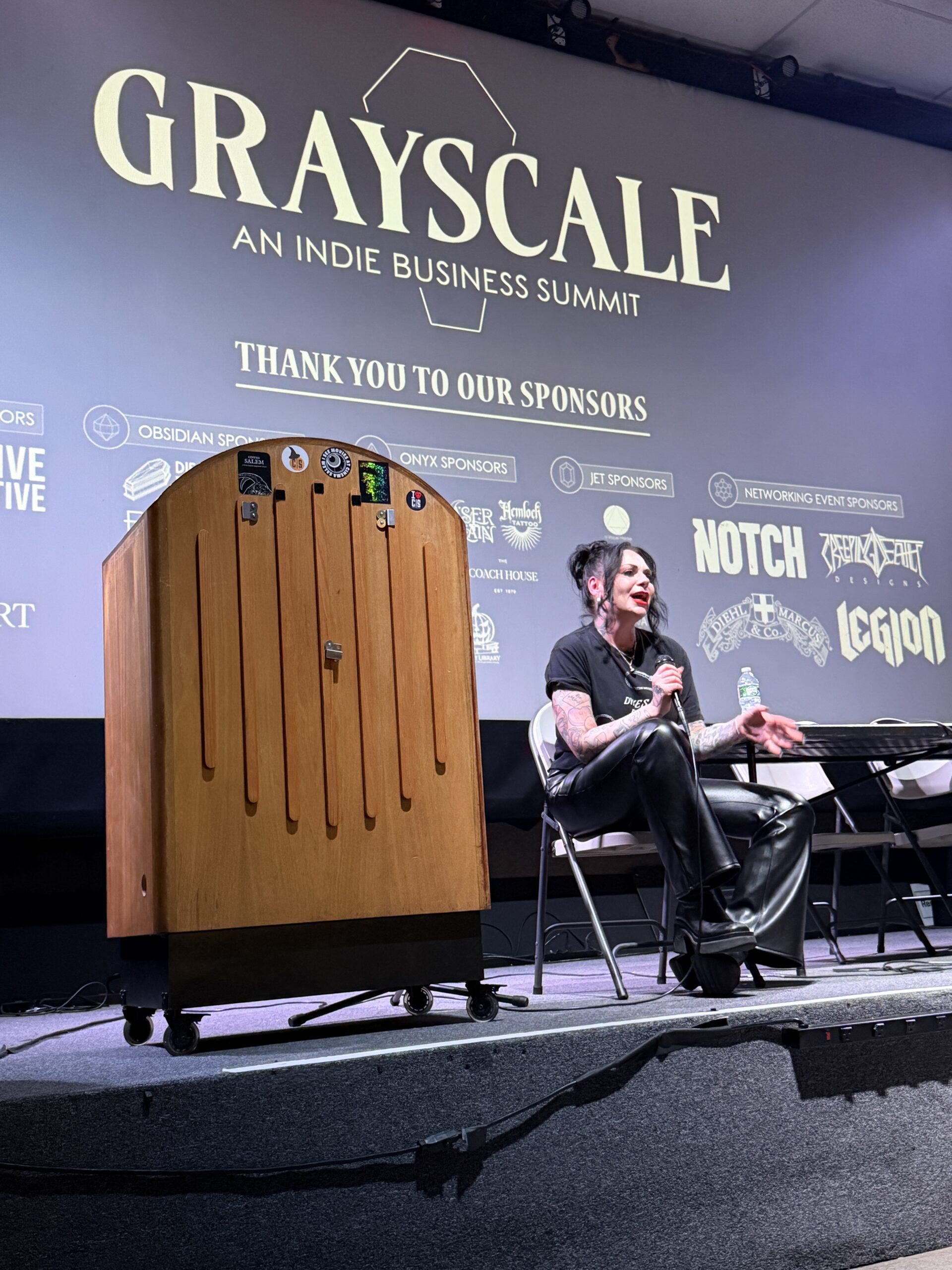
Lindsay Hearts of Foxblood delivers a keynote address titled ‘Tipping the Scales: What to do when you grow faster than you imagined’ at the Grayscale Indie Business Summit at Cinema Salem in Salem, MA.
GRAYSCALE didn’t just prove that this community deserves a seat at the economic development table; it proved it. It proved this community doesn’t NEED the table. Amber and the DWYBO team built their own—in three months, on community trust and hustle—and produced something more valuable than any corporate event with a year-long runway and a six-figure budget. At the closing keynote, Amber challenged everyone to step out of invisible communities and show up where actual power lives. That’s not a tagline. That’s a civic strategy.
But imagine what happens when the broader ecosystem catches up. When economic development agencies start measuring the impact of these businesses. When cities design support programs that actually fit indie retail, not just tech startups. When the tourism strategies that depend on “unique character” and “authentic experience” also invest in the businesses that create that character in the first place.
That’s the opportunity. It was always an opportunity. Now there’s proof.
What’s Coming Next
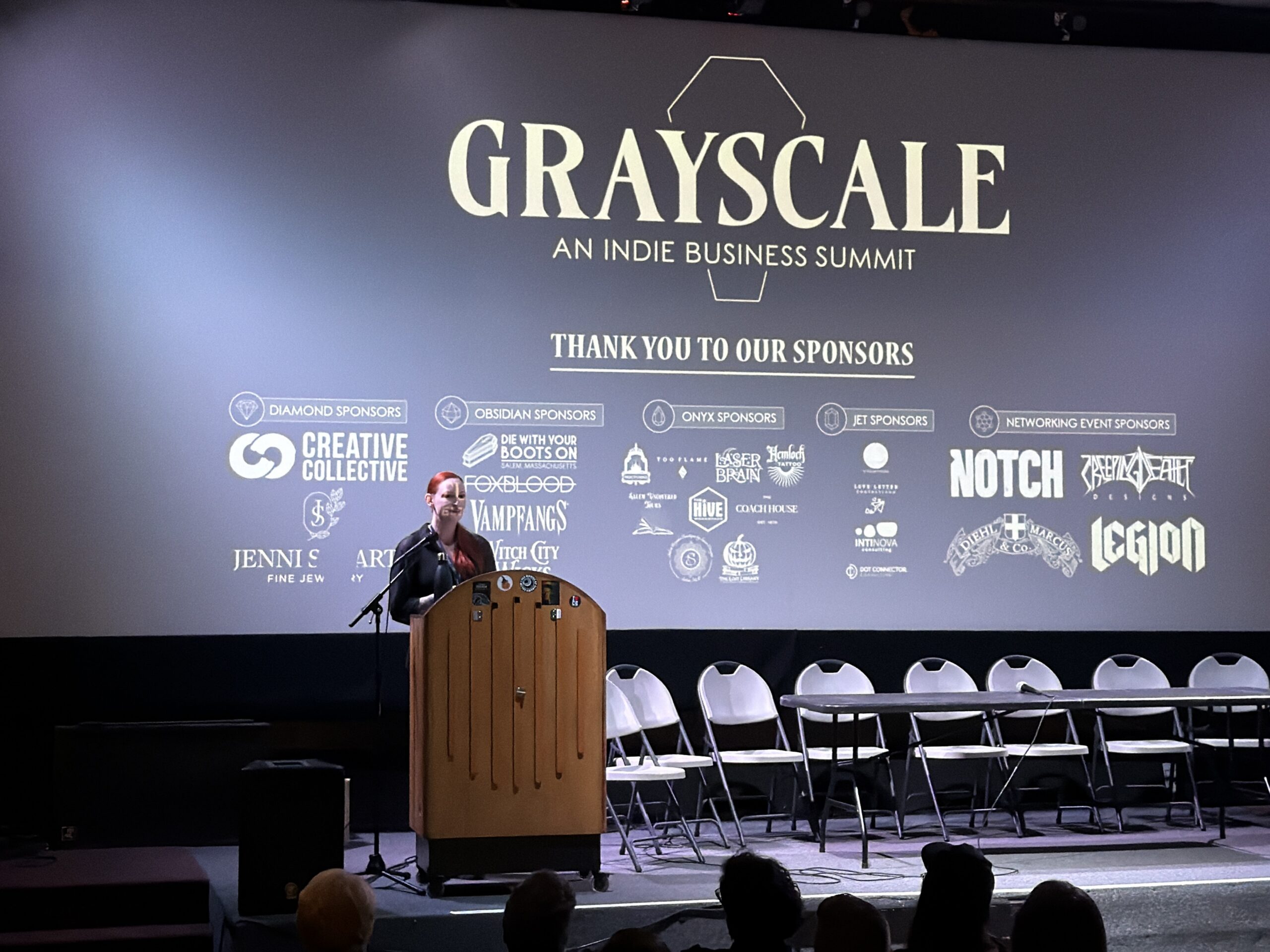
Creative Collective was one of the founding Diamond Sponsors of GRAYSCALE with Jenni Stuart Fine Jewelry, and we were on the ground all three days. We recorded sessions, took notes on everything, and now we’re producing deep-dive breakdowns of many of the twenty-three panels and keynotes—specific takeaways, standout quotes, and what each conversation means for YOUR business. We’ll be releasing them alongside a full summit overview so you can get the value of being in that room even if you weren’t there. If you were there, these will help you remember what you wanted to.
Follow Creative Collective so you don’t miss a single one. Share the ones that speak to someone you know.
The businesses at GRAYSCALE aren’t asking for permission. They never were. They’re already building. And after three days in that room, I can tell you—if you’re still wondering whether the weird kids can build something real, you’re not paying attention.
I closed the summit by asking the room: Did you start the thing? Did you apply for the thing? Did you say yes to visibility? Did you show up for someone else? Because the difference between inspiration and movement is that movement happens when you walk out of the room and actually DO the thing you’ve been thinking about.
I’ll see you out there. NOW GO OUT THERE AND DO THE FU*KING THING!
John Andrews is the founder of Creative Collective MA, a member business support ecosystem serving entrepreneurs, makers, small businesses, nonprofits, and creative professionals across Essex County’s North Shore.

Sources cited:
- Gothic fashion market: Goth Fashion Industry Statistics 2025
- MA creative economy: MASSCreative – Creative Economy and Workforce
- National arts/culture GDP: Mass Cultural Council – Arts & Cultural Industries
- Salem tourism $144M: Destination Salem 2025 Annual Meeting
- Salem October visitors: Destination Salem Press Release, Nov 2025
- Independent retail economics: Association for Enterprise Opportunity
- TikTok Shop data: Red Stag Fulfillment
- FOXBLOOD: Home Business Magazine / RM Creative Services
- All panel quotes: Creative Collective on-site documentation, GRAYSCALE, Mar 31–Apr 2, 2026

Die With Your Boots On
View their Member Listing
Die With Your Boots On was established in 2018 to fill a void in the Salem, MA community. With a large number of locals being members of the heavy metal, gothic, and punk subculture, Salem lacked a business designed to keep them in clothing as black as their hearts. The underground community grew up, had kids, got jobs, and bought
SEE LISTING