
What Running A Business Actually Costs Depending On Who’s Running It
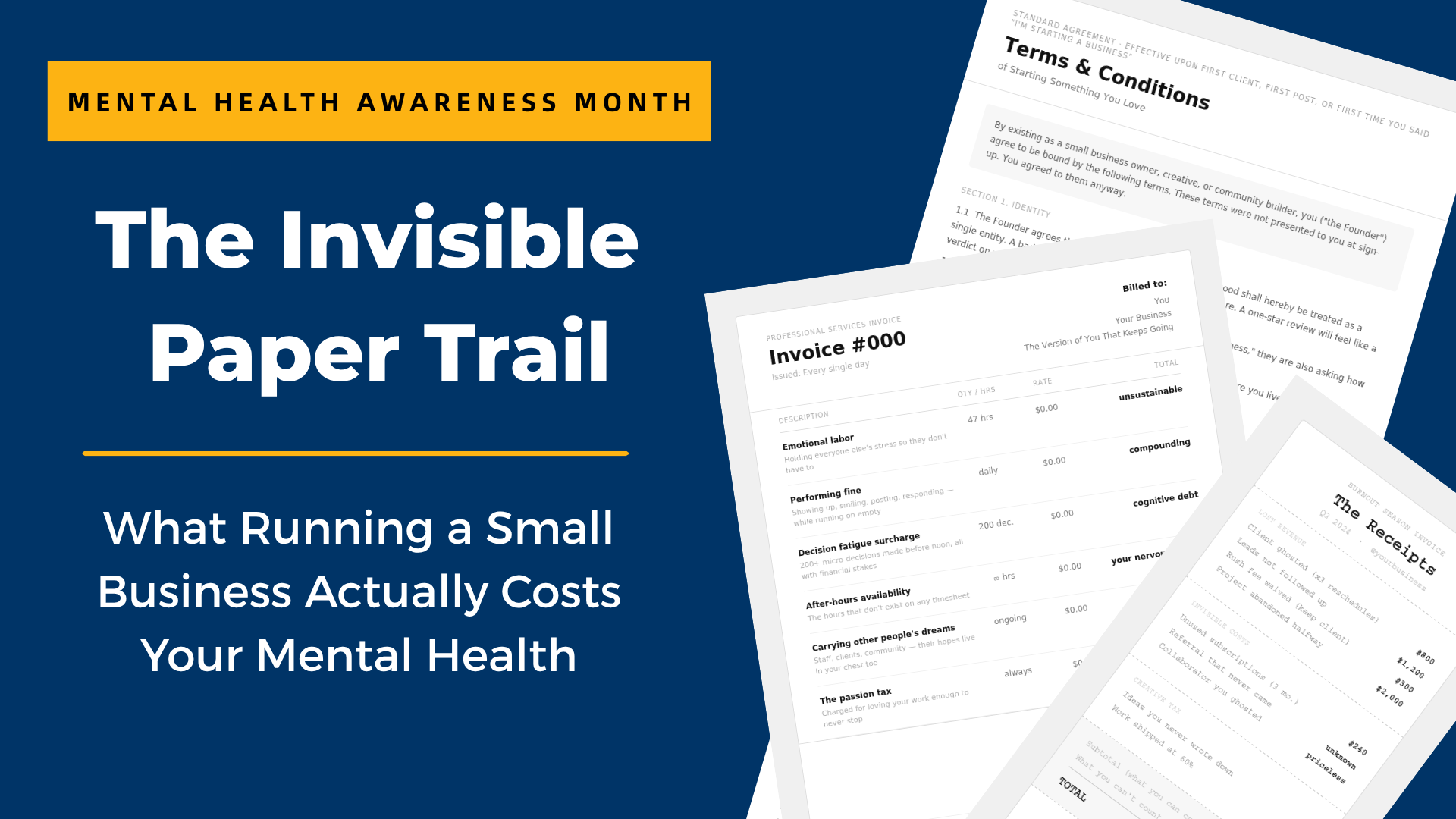
Earlier this year, for Mental Health Awareness Month, The Invisible Paper Trail looked at the invisible agreement every small business owner signs without reading — the one where your identity and your business merge, where a slow month starts to feel like a verdict on your character. That agreement is real for every entrepreneur, but it isn’t the same agreement for everyone.
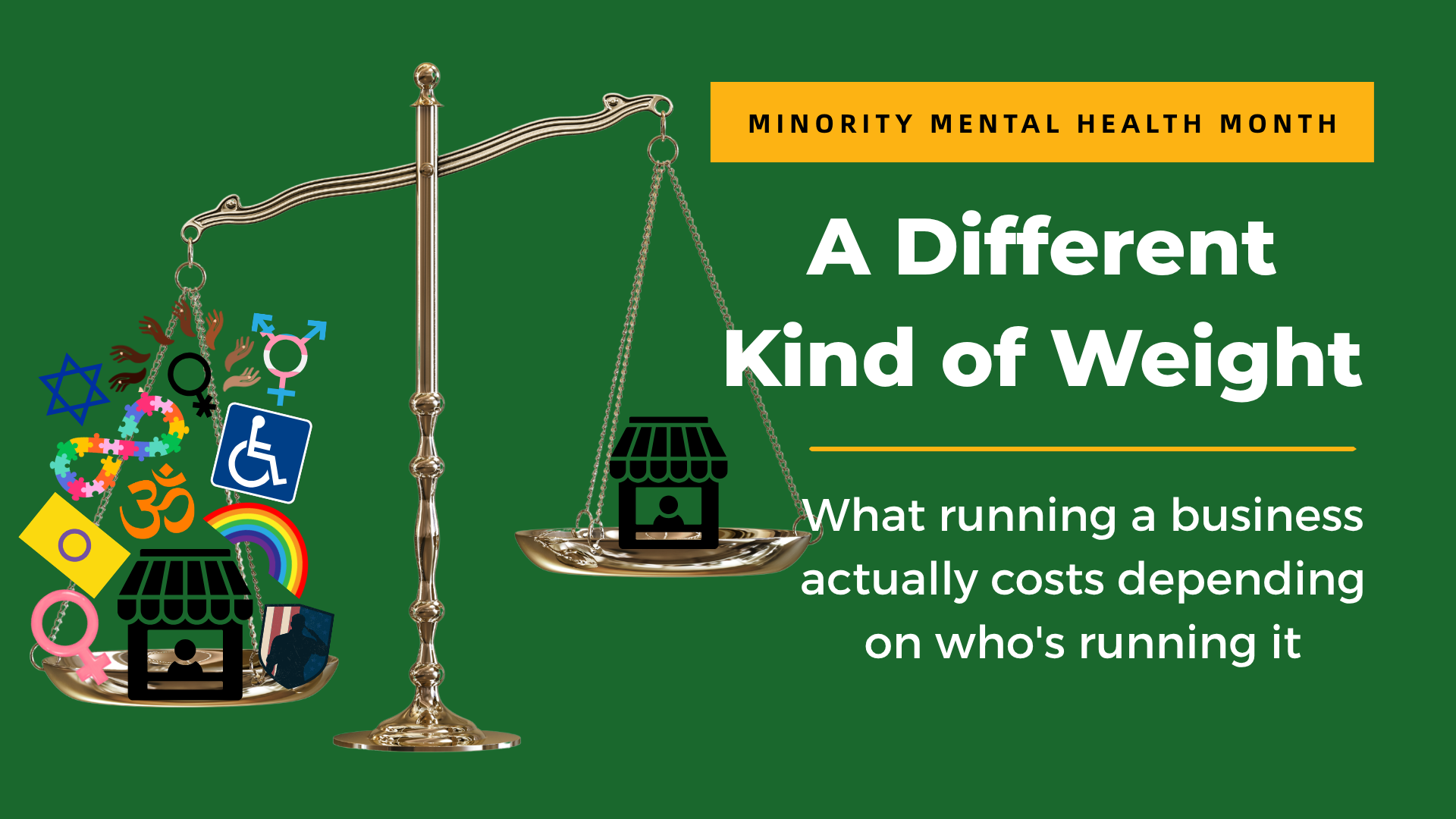
For business owners and creatives who are Black, Indigenous, Latinx, AANHPI, LGBTQIA+, people with a disability, neurodivergent, immigrants or first-generation Americans, religious minorities, veterans, or otherwise part of a minority community, there’s often a second layer underneath the first one. It doesn’t show up on a P&L statement, and it rarely gets named in the usual small-business-mental-health conversation. This is an attempt to name it.

The Weight That Doesn’t Show Up In The Numbers
Every entrepreneur carries decision fatigue, financial risk, and the loneliness of being the only name on the door. But depending on who you are, there’s often an additional tax and extra costs running quietly in the background:
- Being “the only one” in the room — the only Black founder at the funding pitch, the only queer-owned shop in the spotlight reel, the only visibly disabled vendor at the market — and carrying the pressure of representing a whole community in that room, whether anyone asked you to or not.
- Code-switching or covering as unpaid labor. Adjusting how you speak, dress, present, or move through a space depending on the client, the room, or the platform isn’t just tiring. For LGBTQIA+ owners, this might mean deciding how “out” to be with a given customer or vendor. For owners with a disability, it might mean masking pain, fatigue, or access needs to seem “fine” in a meeting. Either way, it’s another job layered on top of the first one, and it rarely gets acknowledged as work.
- Starting further back. Generational wealth, family capital, and inherited networks are often the quiet safety net under other founders’ risk-taking. That gap shows up differently depending on identity — a founder with a disability may also be absorbing costs of accessible equipment or care that never show up in a standard business plan; an LGBTQIA+ founder may have been cut off from family financial support altogether. Without that net, every decision carries a little more exposure, and every setback lands a little harder.
- Distrust that was earned somewhere else. Many minority entrepreneurs carry a learned wariness of institutions — banks, insurers, healthcare, even HR systems — shaped by real history (i.e. redlining, etc.), not paranoia. That wariness doesn’t disappear when you become a business owner. It just finds a new context to operate in.
- Invisible access costs. For business owners with a disability specifically, there’s often a layer of labor and expense that’s simply never discussed in entrepreneurship spaces: navigating inaccessible venues, managing energy limits around a schedule built for people without them, or explaining a need for accommodation to people who’ve never had to ask.
- Unpaid cultural translation. Being treated as the default person who explains their community and culture to colleagues, clients, or partners — or the go-to voice on diversity and accessibility in professional settings — without ever being asked or compensated accordingly for it.
- A different cost of capital. Loan terms, funding access, and even “minority-owned” grants can come with extra scrutiny or reporting, and with the quiet pressure that one business’s failure will reflect on the whole category it represents.
- Financial cliffs that don’t apply to everyone. For owners with a disability in particular, growing a business can mean risking benefits eligibility in ways that make ordinary growth decisions financially dangerous.
- Safety calculations other owners don’t have to make. Where to locate a storefront, how visible to be online, whether to attend certain events or travel to certain areas — plus, for LGBTQIA+ owners, deciding how much of a personal life to reveal in marketing or client-facing content, knowing it could cost customers either way.
- Credibility that has to be earned at least twice. Competence often gets assumed away first, requiring proof before the benefit of the doubt that other founders get by default — paired with the opposite risk of being read as “too much” for the same behavior that reads as confident in someone else.
- Tokenism fatigue. Being invited to the panel, the photo, or the feature as the representative face of diversity — which can feel validating and hollow in the same moment.
- Borrowed time that isn’t on the calendar. Carrying grief or crisis response for a broader community — a public incident, a policy change, a loss — while still showing up for clients the next day, with no built-in recovery time for any of it.
When The Stereotype Is “Positive”
Not all of this weight comes from bias in the obvious sense. Some of it comes from stereotypes that sound like compliments.
The “model minority” myth, often mistakenly applied to the AANHPI community and other minority “accomplished” entrepreneurs by set standards that are not culturally competent or inclusive, implies that success should come easily and quietly. The “strong Black woman” trope implies that endurance is simply a trait, not a response to survival. Both frame struggle as out of character rather than ordinary — which makes asking for help feel like breaking an image, not just addressing a problem.
These stereotypes are harder to push back on precisely because they’re worn as praise. Nobody organizes support around someone being “surprisingly resilient.” But that praise still carries an expectation to keep absorbing more without complaint, and it can make it genuinely difficult to recognize burnout in yourself when the story you’ve been told — and may have told yourself — is that this is just who you are.
None of this is a complete list, and it isn’t meant to be. What’s named here only scratches the surface — the fuller reality is as varied as the people living it, shaped by individual history, community, and circumstance in ways no single post could capture.
None of this means any one group’s struggle is bigger or more legitimate than another’s. It means these costs are different depending on who’s carrying them, and different problems need to be named accurately before they can be addressed at all.
When More Than One Of These Identities Overlap
Most of the conversation around minority mental health treats each identity as its own separate category — as if being a woman of color, or a queer person with a disability, means simply adding two lists of struggles together. That’s not quite how it works.
A Black woman running a business isn’t managing racial bias one day and gender bias the next. She’s often managing both at once, in the same meeting, from the same person, in ways that are hard to separate or even name cleanly. A queer entrepreneur of color may find that spaces built for one part of their identity don’t fully hold the other — a business network that’s racially affirming but not queer-friendly, or an LGBTQIA+ space that doesn’t reflect their cultural background. A person of color with a disability may be weighing accessibility needs and racial dynamics in the same room, deciding which one is safer to raise first, or whether either is safe to raise at all.
This is intersectionality, and it matters here because the support that helps with one part of someone’s identity doesn’t automatically help with all of it. A resource built for “women in business” may not be built for Black women specifically. A resource built for “entrepreneurs of color” may not be built with disability or queerness in mind. The gap isn’t a lack of good intentions — it’s that most support is designed around a single identity at a time, and most people don’t live that way.
Naming this isn’t about making things more complicated than they need to be. It’s about being realistic about the weight that doesn’t add up in a straight line — for a lot of people, it compounds.
Why “Self-care” Often Misses The Target
A lot of mental health messaging aimed at entrepreneurs defaults to individual fixes: rest more, set boundaries, see a therapist, delegate what you can. All good advice, and all of it assumes a starting point that isn’t universal.
“See a therapist” assumes therapy is affordable, covered, and available near you — and that when you get there, you won’t spend the first several sessions explaining context a culturally fluent provider would already understand. “Set boundaries” assumes the people on the other side of those boundaries will respect them, rather than reading a queer founder’s boundary as difficult or a founder with a disability’s boundary as an inconvenience. “Delegate” assumes there’s a team to delegate to, and that hiring won’t reintroduce the same bias a founder is already absorbing elsewhere. “Take a week off” assumes the business, and the people depending on it, can survive a week without the one person doing the emotional translating, the code-switching, the accommodating.
None of this is a reason to skip rest or support. It’s a reason to be honest that generic advice, applied evenly, doesn’t land evenly. For minority business owners specifically, the barrier is rarely willingness. It’s whether the support on offer was actually built with their circumstances in mind, or just assumed to fit everyone the same way.
That distinction is exactly what makes certain kinds of support stand out. Some resources are built generically and hope they apply broadly. Others are built specifically, from within the community they’re meant to serve, and it shows in how they operate.
Members Carrying This Weight And Building Around It
Many of Creative Collective members reflect exactly this kind of resilience, running businesses that double as community anchors even while absorbing the extra weight described above:
 North Shore Juneteenth Association — building year-round cultural infrastructure in a region where that work is still often treated as seasonal.
- The Ladies Entrance — a women-only holistic studio built specifically as a space where clients don’t have to leave their cultural context at the door.
- Annadidathing — a first-generation Filipino American muralist whose work explores identity as a mixed-race person in the U.S., including themes of growth and mental health, directly through public art.
- Cultura Latina Dance Academy — a woman- and BIPOC-owned cultural institution in Lynn preserving Latin dance and folklore as both art form and heritage.
- Dot Connector Consulting — founded to replace traditional networking with strategic, authentic connection specifically for BIWOC business owners and professionals.
- Koto Asian Fusion — an AAPI- and woman-owned restaurant in Salem built around honoring Japanese, Chinese, and Thai culinary traditions.
- Wicked Good Books — a woman- and neurodivergent-owned independent bookstore built on an explicitly heart-led, inclusive approach.
- Seacoast Stilettos — a trauma-informed, radically inclusive, LGBTQ-owned dance studio welcoming all bodies, identities, and backgrounds onto the dance floor.
- Millennium Latino Project — a Latino-focused professional network built specifically for first-generation leaders navigating career spaces without the traditional family business backgrounds many networking models assume.
- French Press Candle Co. — an LGBTQ-owned candle company built on clean ingredients and a public commitment to animal welfare.
- Salem School of Witchcraft — an LGBTQ- and neurodivergent-owned business that creates employment opportunities specifically for underserved women and supports disabled and elderly community members.
- The Satanic Temple — a recognized religious minority organization with a public gallery and event space in Salem, representing the kind of belief system that still carries real stigma and misunderstanding in professional and community settings.


This list is intentionally a starting point. If you’re a Black-owned, LGBTQIA+-owned, disability-owned, or otherwise minority-owned business in our community carrying this kind of weight, we’d like to include your story too — reach out and let us know.
Where To Start
Seeing your own experience reflected in a list of member businesses is one thing. Actually doing something with that recognition is another. You don’t need to overhaul how you run your business or rewrite your relationship with mental health this month. Start smaller, and start specific:
- Name the specific version of the weight you’re carrying — not generic entrepreneur burnout, the particular one. Is it the cost of being “the only one” in certain rooms? The tax of translating your own culture for other people all day? Something else entirely? Precision matters here, because a vague sense of being tired doesn’t point you toward what actually needs to change.
- Talk to one other business owner who shares that context. Not everyone. Not a networking event. One person who would understand the specific version of the weight without you having to explain it from the ground up first.
- Notice where the weight is showing up in your body, not just your calendar. Clenched shoulders during certain client calls, a tight chest before certain meetings, exhaustion that shows up after code-switching rather than after physical work — these are data, not just discomfort.
- Look for support that was built with your specific context in mind, rather than generic advice applied evenly across every kind of business owner. The members named above are one place to start, not the only one.
- Give yourself permission to not have this figured out by the end of the month. Minority Mental Health Month is a prompt, not a deadline. Naming even one piece of this weight honestly is enough progress for now.
None of these steps require certainty about where they lead. They just require being willing to start.
If you’re not sure where to start, or you’re looking for support that fits your specific circumstances, reach out to us directly — we’re happy to help point you toward the best person, resource, or member in our community.
The Terms Are Still Being Written
The agreement you signed when you started your business didn’t account for this layer of weight, and it was never fully yours to negotiate alone in the first place — it was shaped by whoever built the systems, spaces, and expectations you’re operating inside of. Naming it accurately is the first step toward changing your relationship to it, even if the terms themselves take longer to shift.
You didn’t choose the weight described in this post. But you get to choose what you do next: who you talk to, what support you look for, and whether you keep carrying this in silence or say it out loud to someone who’s ready to hear it. That choice is smaller than fixing everything at once, and it’s the one that’s actually in front of you today.
This story comes from the Creative Collective community
Essex County businesses who believe when we thrive together, our whole region becomes more vibrant. We’re entrepreneurs, creators, and service providers across all industries, collaborating to build the community we want to be part of. If you see your business as more than just commerce — as a way to contribute to our regional ecosystem — you belong here. Discover how to join our community →

French Press Candle Co. | Artisanal Soy Candles & Home Fragrance
View their Member Listing
French Press is dedicated to delivering quality, hand crafted home fragrance products to accessorize your home. Our signature scents are inspired by shared experiences to fill your home with warmth, brightness, and seasonal comfort. Driven by our obsession for French Bulldogs, we donate a portion of our proceeds to animal rescue organizations across the country.
SEE LISTING